01 · Why the Moon Is Never Empty
Look at the full moon tonight, and you will see what Chinese children have always seen: a story. The bright craters and dark plains that telescopes call seas are, in Chinese imagination, a palace — and it is not empty. A goddess lives there, alone with a white rabbit and a woodcutter who will never finish his work. For more than a thousand years, every Mid-Autumn Festival has been an evening spent gazing at this story, and every mooncake eaten at the table below is a small piece of it.
This is the myth behind the mooncake: the tale of Chang’e (嫦娥), the Jade Rabbit (玉兔), and the strange household of the moon.
02 · The Archer Who Saved the Earth
Long ago — so the story begins — the sky held ten suns, and each one took its turn crossing the heavens. Then, one day, all ten rose together. The earth scorched; rivers boiled; crops turned to ash. The people had no way to live.
A hero named Hou Yi (后羿) stepped forward. Hou Yi was the greatest archer who ever lived, and he did what no one else dared: he drew his bow and shot down nine of the ten suns, one arrow after another, until a single sun remained to warm the world. The people were saved, and the Queen Mother of the West, moved by his deed, rewarded him with the most precious gift she possessed — the elixir of immortality, a medicine that would let him live forever. Hou Yi carried it home and hid it beneath the rafters, saving it for the right moment. He did not know that someone was watching.
03 · The Flight to the Moon
The one who watched was Peng Meng (逢蒙), a disciple who coveted the elixir for himself. One day, while Hou Yi was away hunting, Peng Meng broke into the house and demanded the medicine at sword-point.
Chang’e, Hou Yi’s wife, understood what would happen if such a man lived forever. In that breathless moment she made her choice: she took the elixir herself and swallowed it in one gulp, so that it could never be stolen. At once her body grew light as silk. She drifted up through the roof beams, out past the eaves, and into the night — floating toward the moon, the brightest thing in the sky. She had saved the elixir from the wrong hands, but she had also left everything she loved behind.
When Hou Yi returned and saw what had happened, he wept before the moon. He set out a table of fruit and incense in the courtyard, hoping to call her home. The offerings cooled in the night air; Chang’e did not return. But the tradition did not die: from that evening on, on the fullest moon nights of the year, families set out sweet offerings and look up — a small gift of love to a woman who chose the world over herself.
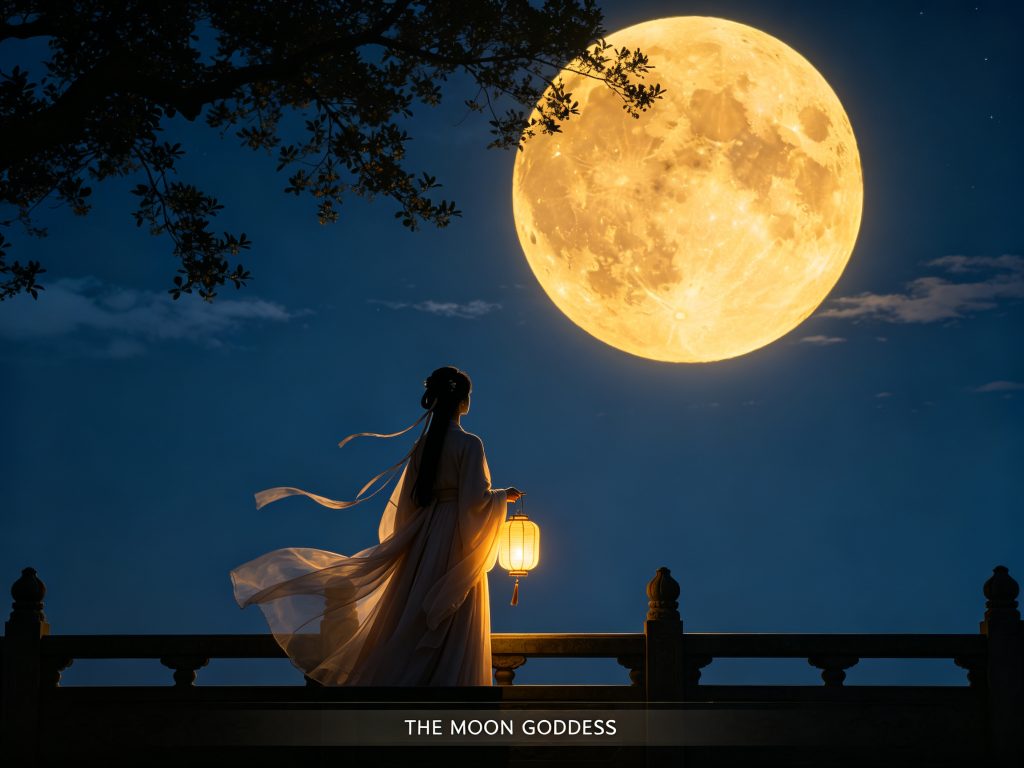
THE MOON GODDESS — Chang’e floats toward the palace of the moon (illustration)
04 · The Jade Rabbit and the Woodcutter
Chang’e did not live in the moon alone, and the moon’s other residents explain two of its oldest riddles. The first is the Jade Rabbit (玉兔, yùtù). On the moon’s surface, ancient stargazers saw not a “man in the moon” but the shape of a rabbit, pounding herbs in a mortar — the medicine of immortality, ground forever with a stone pestle. The Jade Rabbit is Chang’e’s companion and the moon’s chemist, diligently mashing the elixir for eternity. Ask a Chinese grandparent why the moon has dark spots, and the answer is simple: that is the rabbit’s shadow at work.
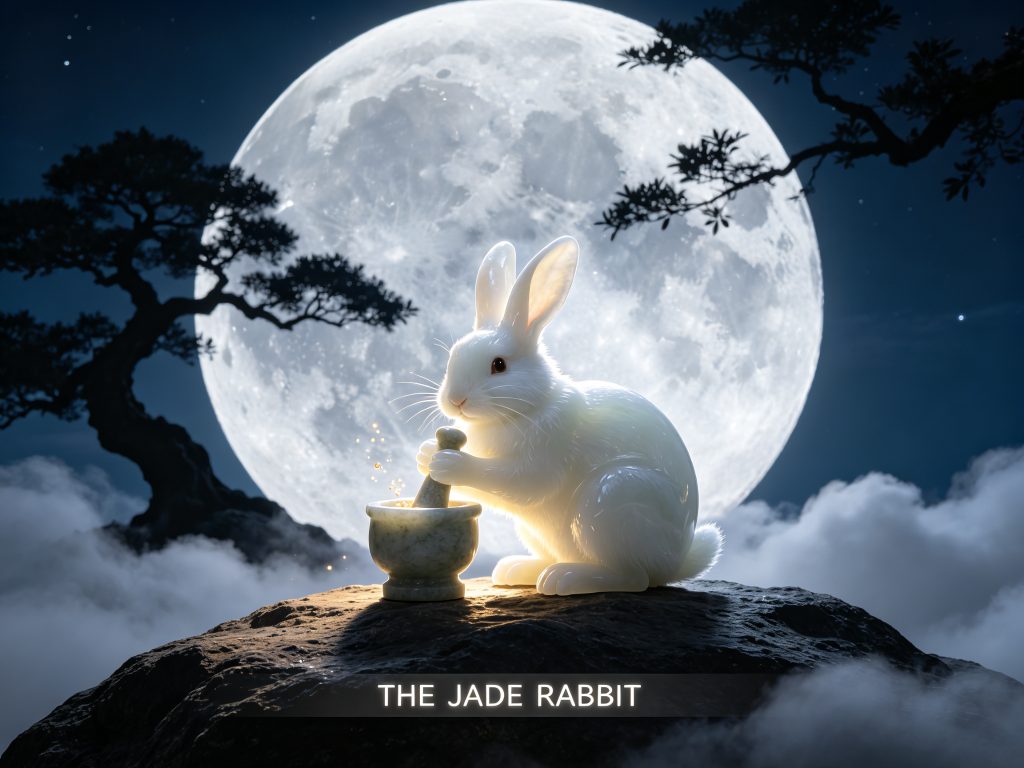
THE JADE RABBIT — pounding the elixir of life under the osmanthus tree (illustration)
The second resident is Wu Gang (吴刚), a woodcutter punished for his pride. The gods set him to cutting down a great osmanthus tree on the moon — a tree that heals its own wounds every night, so that each day’s labor begins again at dawn. Wu Gang’s endless chopping is the Chinese image of futility, but it also gives the moon its fragrance: the osmanthus tree that blooms forever in the moonlight, the very tree whose golden flowers scent Chinese autumn — and whose story we tell in our article on osmanthus, the fragrance that announces the season.
05 · The Mooncake Uprising
The mooncake’s own legend is younger, and entirely this-worldly. In the fourteenth century, the story goes, China was ruled by the Mongol Yuan dynasty, and rebellion was stirring in secret. A rebel leader named Zhu Yuanzhang needed to pass a message across the country without alerting the authorities — the date on which every corner of China would rise at once. His followers baked the message into small round pastries and passed them around as festival gifts: on the fifteenth day of the eighth month, open the cakes, and the uprising would begin. The night came, the cakes were opened, and the story says the rebellion was set in motion.
Historians treat the tale with proper caution — there is no contemporary record of mooncake messages — but that has never mattered to its audience. Every Mid-Autumn, children break open their mooncakes and hear how a pastry helped found a dynasty. It is why, more than anything else, the mooncake is not just food: it is a message, hidden in plain sight, passed from hand to hand across the centuries.
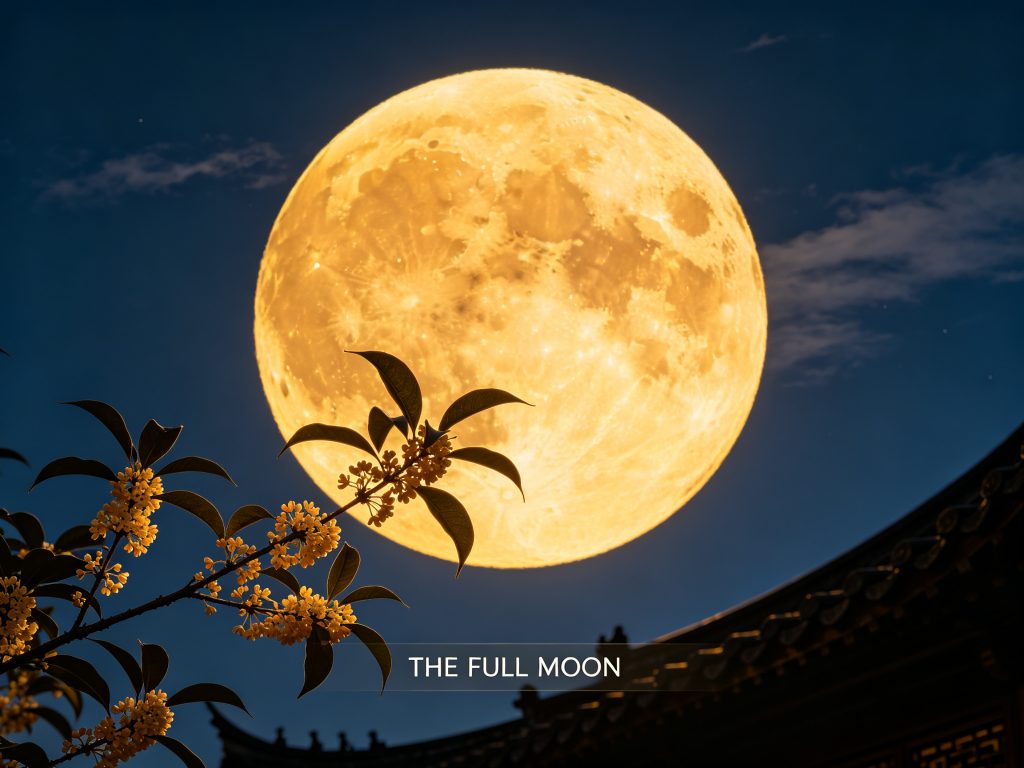
THE FULL MOON — the night the cakes were opened (illustration)
06 · What the Myth Leaves Behind
Strip away the gods and the archery, and three ideas remain, and they are the quiet engine of Mid-Autumn Festival. Chang’e teaches that duty can demand the cruelest loneliness — and that love finds a way to speak across it anyway, which is why families still set out offerings and raise their eyes. The Jade Rabbit and Wu Gang teach that the moon is a place of endless, patient work, and that even what never finishes can be a comfort. And the mooncake — round, sweet, shared, and hiding a message inside — teaches that the most important things are the ones folded into a small round object and handed across a table.
When you hold a mooncake this season, you are holding all of it: a goddess’s sacrifice, a rabbit’s endless grinding, a woodcutter’s impossible tree, and a rebel’s hidden note. Every culture has its man in the moon. Only China’s moon holds a family.
The Cast of the Moon
| 中文 | Pinyin | Role in the Myth |
|---|---|---|
| 嫦娥 | Cháng’é | the moon goddess, who drank the elixir to keep it from being stolen |
| 后羿 | Hòu Yì | the hero archer who shot down nine suns |
| 玉兔 | Yùtù | the jade rabbit, pounding the elixir of life in the moon |
| 吴刚 | Wú Gāng | the woodcutter sentenced to cut a self-healing osmanthus tree |
| 月饼 | yuèbǐng | the mooncake, once a hidden message, now the taste of reunion |
Related on ccpark
- Mid-Autumn Festival 2026: Date, Legends, and How China Celebrates
- Osmanthus: The Golden Fragrance That Signals Autumn in China
- How to Celebrate Mid-Autumn Festival: Mooncakes, Moon Gazing, and Family Rituals (coming soon)