Part of the “Garden Art” series — how China builds poetry in three dimensions · Reading time: 5 minutes
A Poem That Turns Golden
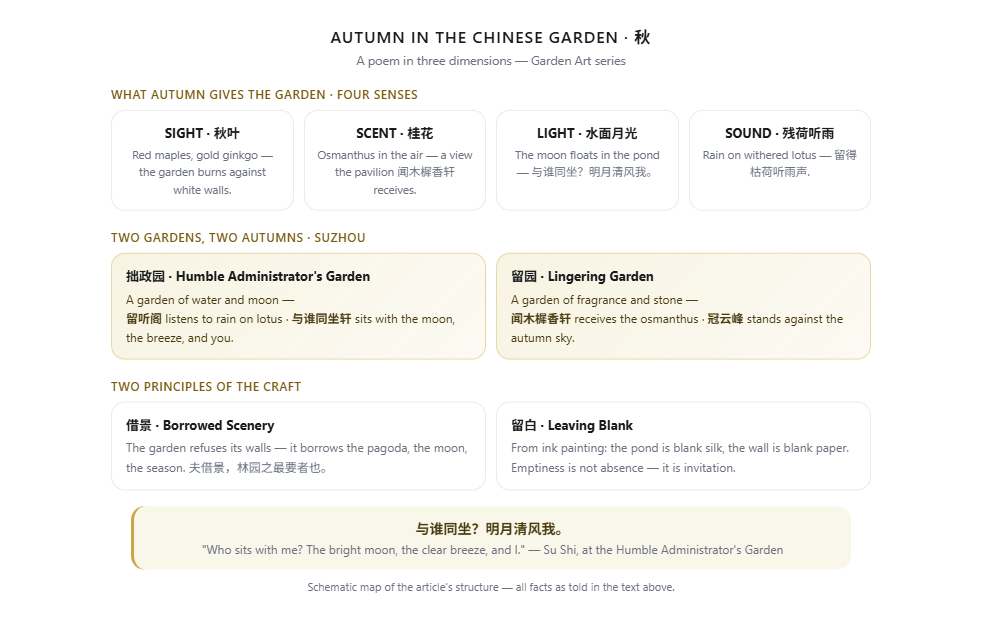
It is often said that a classical Chinese garden is “a poem made solid, a painting made three-dimensional.” Every season rewrites that poem, but autumn writes the best stanza. Red maples burn beside whitewashed walls, ginkgo leaves fall in drifts of gold, the osmanthus releases its invisible fragrance, and the evening moon floats in the pond like a line of calligraphy. This is the Chinese garden at its truest — not the green abundance of summer, but a quieter, more deliberate beauty. Autumn gardens in China are gardens as their designers intended them to be seen: reduced, reflective, and almost silent.
Why Autumn Suits the Garden
The classical garden was never built to dazzle; it was built to be inhabited by the mind. Its masters pursued 天人合一 (tiān rén hé yī) — the unity of heaven and humans — by compressing mountains, rivers, and seasons into a single courtyard, a technique known as 小中见大 (xiǎozhōng jiàndà): “see the great within the small.”
Spring brings abundance, but abundance is easy. Autumn brings restraint: leaves fall, colors deepen, the light turns oblique and golden, and the garden is slowly emptied. And that emptying is precisely the point. A garden without the noise of blooming reveals its bones — its rocks, its water, its empty spaces. Chinese garden aesthetics are the aesthetics of what is left out, and no season removes more than autumn.
Two Gardens, Two Autumns
The Suzhou classical garden autumn is the finest of its kind. Suzhou’s classical gardens were inscribed on UNESCO’s World Heritage List in 1997, and two of them frame the season perfectly.
The Humble Administrator’s Garden (拙政园,Zhuōzhèng Yuán)
Built in the early sixteenth century by a retired Ming official who named it, half in jest, after a phrase meaning “this is how a clumsy man governs,” the garden is dominated by water — ponds, lotus, and reflections. In autumn, two of its pavilions come into their own:
- 留听阁 Liútīng Gé — the Pavilion for Listening to Rain. Its name comes from a line by the Tang poet Li Shangyin: 留得枯荷听雨声 — “Leave the withered lotus, that you may hear the rain.” In summer the pavilion looks at blooming lotus; in autumn it listens to rain drumming on the dead leaves — a sound Chinese poets rank among the finest of the year.
- 与谁同坐轩 Yǔshéi Tóngzuò Xuān — the “Who Sits with Me?” Pavilion. A fan-shaped pavilion named after Su Shi’s line: 与谁同坐?明月清风我 — “Who sits with me? The bright moon, the clear breeze, and I.” Sit there on an autumn evening, and the moon appears in the water beside you — the same moon we wrote about in our first article.
The Lingering Garden (留园,Liú Yuán)
The name 留,”to linger,” promises a garden that stays with you after you leave. Its autumn is carried by two things:
- 闻木樨香轩 Wén Mùxī Xiāng Xuān — the Pavilion for Smelling the Osmanthus. 木樨 (mùxī) is the osmanthus, and in late September its tiny gold flowers release one of the most famous scents in Chinese culture. The pavilion is built to do nothing but receive it. In the Chinese garden, scent is a legitimate view.
- 冠云峰 Guānyún Fēng — the Cloud-crowned Peak. A six-metre-tall rock of Taihu limestone, one of the most celebrated stones in China, standing alone in a courtyard like a mountain. Against an autumn sky it reads less as stone and more as a line of landscape painting.
借景: The Art of Borrowing the World
Ji Cheng, the great theorist of garden design, wrote in his seventeenth-century treatise The Craft of Gardens (《园冶》): 夫借景,林园之最要者也 — “Borrowed scenery is the most important principle of the garden.”
Jièjǐng (借景) means the garden refuses to end at its walls. It borrows the mountains beyond, the pagoda on the horizon, the moon overhead, the season itself. The most famous example is in the Humble Administrator’s Garden: stand by its central pond and look through the round gate, and the North Temple Pagoda — a real pagoda, outside the garden, nearly a kilometer away — appears to rise from inside the grounds. The wall does not enclose the view; it frames it.
Autumn is the season of 应时而借 — “borrowing according to the season.” The garden borrows the crisp air, the red hills beyond Suzhou, the fragrance of osmanthus, and the full moon of Mid-Autumn. An autumn garden is a container for things it does not own.
留白: The Art of Leaving Blank
The companion principle comes from painting: 留白 (liúbái), “leaving blank.” In Chinese ink painting, the empty paper is not nothing — it is water, sky, mist, or simply room for the viewer’s imagination. The garden does the same. Its ponds are blank silk for reflections. Its whitewashed walls are blank paper on which bamboo shadows draw themselves at dusk. Its empty courtyards are pauses in a conversation.
And this is why autumn, the season of falling leaves and withered lotus, may be the garden’s truest season. 留白 is not absence; it is invitation. The empty branch, the bare rock, the water with nothing on it — these are where the mind rests. The garden sheds its leaves the way a poem sheds unnecessary words: to leave only what matters, and to leave room for you.
How to See an Autumn Garden
If you visit Suzhou in autumn — and you should — resist the urge to see everything. The Chinese garden rewards slowness. Walk, then stop. Sit in the “Who Sits with Me?” Pavilion until the moon clears the wall. Stand under the osmanthus and close your eyes. Listen to rain on the lotus. The garden was not designed to be toured; it was designed to be kept — the way you keep a poem, by heart.
The classical Chinese garden is a poem in three dimensions, and autumn is its most quoted stanza. Come when the leaves fall, and it will speak.
This article is part of the “Garden Art” series. Next: 太湖石 — how a rock became the soul of the Chinese garden.