Part One of our Mid-Autumn Festival series · Reading time: 5 minutes
More Than a Light in the Sky
Ask a Western friend what the moon means, and you may hear about werewolves, ocean tides, or a man on the moon. Ask in China, and the answer is quieter — and warmer. The moon in Chinese culture is not an object to be studied; it is a companion to be spoken to. For three thousand years, poets have raised their cups to it, lovers have confessed beneath it, and the homesick have looked at it and seen their own front door.
Of all the symbols of Chinese civilization — the dragon, the phoenix, the plum blossom — none is more personal than the moon. It is the most human thing in the sky: it waxes and wanes, it leaves and returns, and every month, without fail, it becomes round again. And in China, roundness is everything.
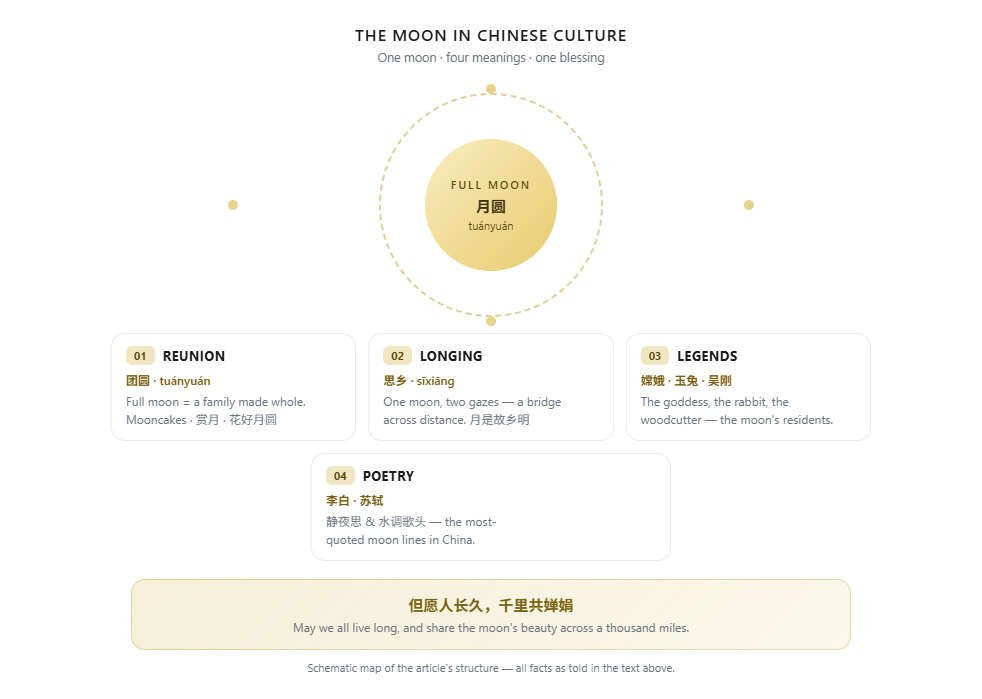
The Full Moon Means Family: 团圆 (tuányuán)
The Chinese word for reunion is tuányuán (团圆) — literally, “round and complete.” No image captures it better than the full moon. This is the heart of full moon China meaning: a full moon is not merely beautiful; it is a promise that what has been separated can come together again.
That is why the most important night of the Chinese year is the fifteenth day of the eighth lunar month — the Mid-Autumn Festival (中秋节,Zhōngqiū Jié) — when the year’s brightest, roundest moon rises. Families gather for a reunion dinner, cut round mooncakes (月饼,yuèbǐng) stamped with the character for longevity, and sit outside to shǎngyuè (赏月) — “appreciate the moon.” The cake is round because the moon is round; the table is round because the family is round. Even the classic blessing 花好月圆 (huāhǎo yuèyuán), “blossoms bloom, the moon is full,” simply means: may everything in your life be complete.
The Moon Carries Longing: 思乡 (sīxiāng)
But the same moon that comforts the reunited reminds the separated of what they lack. In Chinese moon symbolism, the moon is above all a bridge for longing — the homesickness of sīxiāng (思乡) and the ache of missing someone. The logic is beautiful: we cannot be together, but we can look at the same moon, and in that shared gaze, distance collapses.
The Tang poet Du Fu wrote the line every Chinese traveler knows by heart: 露从今夜白,月是故乡明 — “The dew turns white from tonight; the moon is brightest over home.” It is not astronomy. It is love: the moon is not actually brighter in your hometown. It only looks that way, because that is where your heart is.
This is why the moon in Chinese culture is bittersweet — a symbol of reunion for those at the table, and a symbol of longing for those who are missing.
Who Lives on the Moon? Chang’e, the Jade Rabbit, and Wu Gang
On Mid-Autumn night, parents point at the moon’s dark patches and tell their children who lives up there. Three figures have made the moon their home for more than a thousand years.
- Chang’e (嫦娥) — the moon goddess. In the ancient myth, the archer Hou Yi shot down nine of the ten suns that were scorching the earth. As a reward, he received an elixir of immortality — which his wife Chang’e swallowed, in some versions to protect it, in others by force. She floated upward, lighter than air, until she reached the moon, where she lives alone in the Cold Palace (广寒宫,Guǎnghán Gōng). Hers is the loneliest happy ending in Chinese mythology: she gained eternity, and lost her husband for it.
- The Jade Rabbit (玉兔,Yùtù) — a white rabbit who sits beneath a cassia tree, endlessly pounding the elixir of life with a mortar and pestle. Where Chang’e embodies solitude, the rabbit embodies devotion: a small, patient creature keeping her company for eternity.
- Wu Gang (吴刚) — a mortal punished for his arrogance, ordered to cut down the cassia tree. But the tree heals itself with every stroke, so his work never ends. His is a parable of futile toil — a reminder that some debts are paid not in years, but in centuries.
Look closely at the moon tonight, the stories suggest, and you may glimpse the rabbit, the tree, and the lonely goddess — three lives that explain why the moon is both beautiful and sad.
Two Poems Every Chinese Person Knows
No account of the moon in Chinese culture is complete without poetry, because the moon is the most poetic object in the language. Two poems, written nine hundred years apart, are known by heart by nearly every Chinese person.
Quiet Night Thoughts (静夜思) — Li Bai, Tang Dynasty
床前明月光,疑是地上霜。 举头望明月,低头思故乡。
Bright moonlight before my bed — could it be frost upon the ground? I raise my head to watch the bright moon, I lower it, and think of home.
In just twenty characters, Li Bai builds an entire emotional world. Moonlight like frost — cold, white, silent — turns the bedroom into a winter landscape of the heart. One glance up, one glance down: that is the whole movement of homesickness. It is the most memorized poem in China, and the reason the moon will forever be tied to sīxiāng.
Prelude to Water Melody (水调歌头) — Su Shi, Song Dynasty
In 1076, on a Mid-Autumn night, the poet Su Shi — drunk, and seven years apart from his brother — wrote a poem that became the festival’s anthem. Its closing lines are quoted every September:
人有悲欢离合,月有阴晴圆缺,此事古难全。 但愿人长久,千里共婵娟。
People have their partings and reunions, their joys and sorrows; the moon waxes and wanes, now bright, now dim — nothing has ever been perfect since ancient times. May we all live long, and share the moon’s beauty across a thousand miles.
Su Shi does something extraordinary: he forgives the moon. The moon is not cruel to wax and wane — that is simply its nature, just as separation is part of human nature. Perfection was never possible; therefore the only sensible wish is 但愿人长久 — “may we live long.” And if we do, then even a thousand miles apart, 千里共婵娟 — we share the same silver light. A line written to one brother now serves as the Mid-Autumn greeting for the entire Chinese-speaking world.
Moon Words You’ll Hear in September
If you are in China — or on WeChat — around the Mid-Autumn Festival, you will hear these:
- 中秋节快乐 (Zhōngqiū Jié kuàilè) — “Happy Mid-Autumn Festival!”
- 月圆人团圆 (yuèyuán rén tuányuán) — “The moon is full, and the family is reunited.”
- 月饼 (yuèbǐng) — mooncakes, the round pastries that are the festival’s edible symbol.
- 千里共婵娟 — “Sharing the moon across a thousand miles,” the deepest way to say “I miss you.”
The Moon Is Rising
The full moon China meaning is deceptively simple: whatever is separated can become whole again. And that is why, on the night of the Mid-Autumn Festival, hundreds of millions of people do the same thing at the same moment — they step outside, look up, and share the same light.
Tonight, wherever you are, do the same. Find the moon, and think of the people you wish were beside you. In China, that is not sentimentality. It is the whole point of the moon.
This is the first article in our Mid-Autumn Festival series. Next: the story of the mooncake — and why a pastry once carried a revolution.