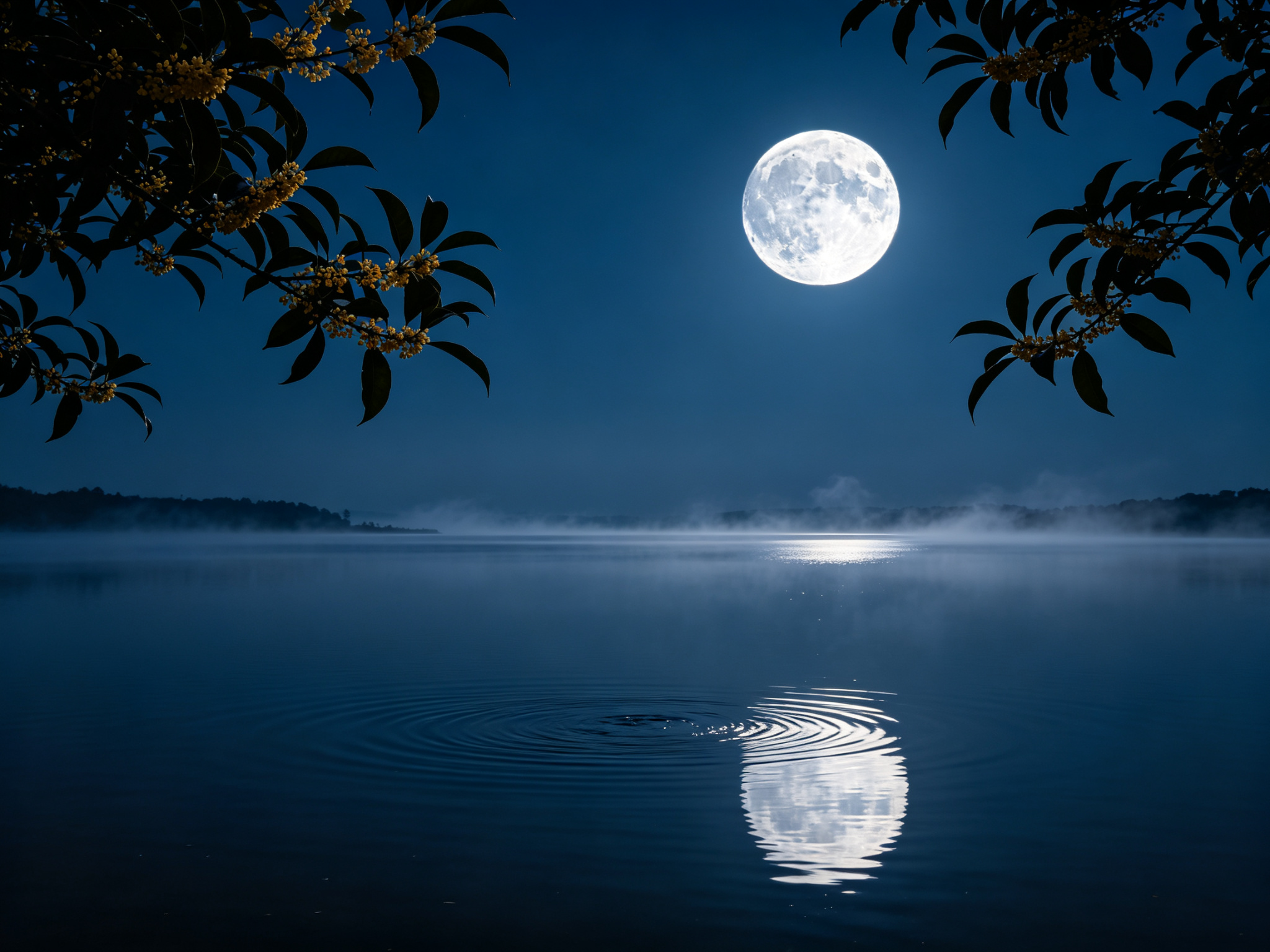
Ask most people what the Mid-Autumn Festival sounds like, and they will describe a busy evening: families gathering for dinner, plates of mooncakes, children carrying paper lanterns, the crackle of fireworks. But there is another way to keep the festival, one that has been practiced in China for more than a thousand years. It requires no lantern, no mooncake, sometimes not even a companion. It asks only that you look up — and keep looking. This is the art of watching the moon in silence: not a pastime, but a meditation.
A Mirror Held Up to the Mind
Zen Buddhism has always had a special affection for the moon. In Chinese Buddhist thought, the moon stands for the mind in its original clarity — bright, complete, and untouched by whatever clouds pass across it. A classic Chan phrase says it in four characters: “a thousand rivers, a thousand moons” (千江有水千江月). The moon does not chase the rivers; wherever there is still water, the moon appears of itself. The practice is not to make the moon rise, but to be still enough that it can be seen.
Buddhist texts even use the moon as a pointer. In the Surangama Sutra, the Buddha holds up a finger toward the moon and tells his listeners: the finger is not the moon. If you stare at the finger, you miss the moon. Moon-gazing in the Zen sense is the same discipline — look past the words, the ideas, the noise, and look at the thing itself. When a Chan master told his disciples to “go watch the moon,” he was not scheduling a picnic. He was assigning a meditation.
Su Shi’s Night of Imperfection
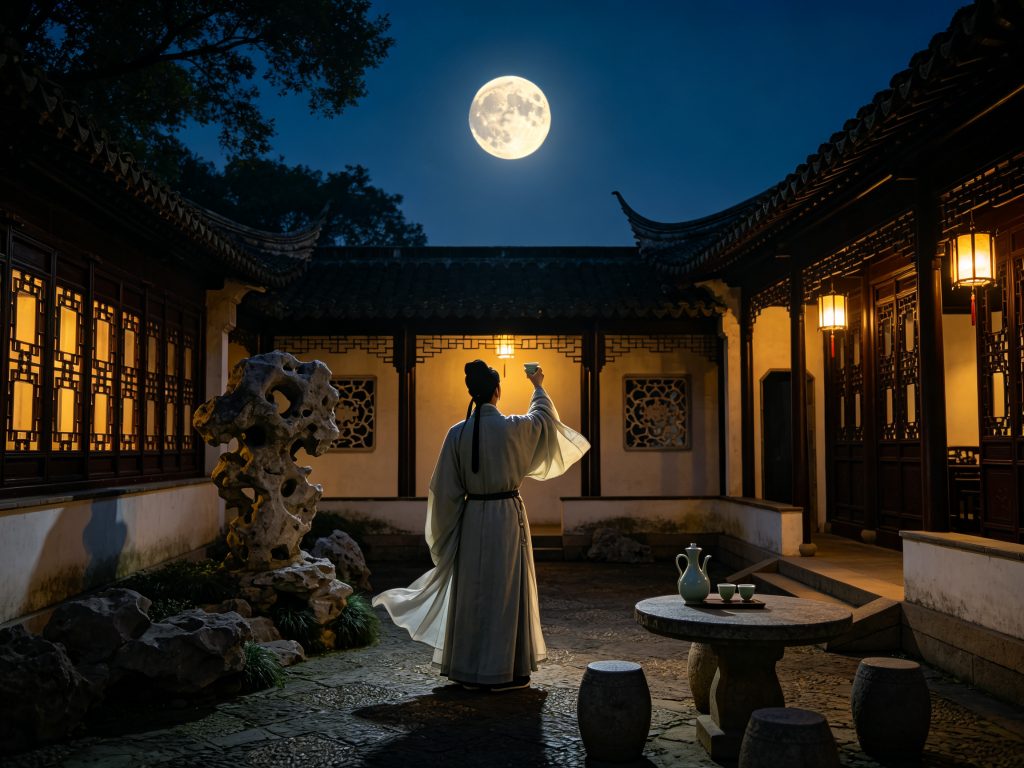
No poem captures this better than the one Chinese families still read aloud every Mid-Autumn. In the autumn of 1076, the poet Su Shi (苏轼) was the governor of a remote town called Mizhou (密州, today’s Zhucheng in Shandong). He had not seen his brother and closest friend, Su Zhe, for seven years. On the night of the full moon he drank until dawn and wrote a ci poem with a short preface: “On the Mid-Autumn night of the bingchen year, I drank happily until dawn, was thoroughly drunk, and wrote this piece, in memory of Ziyou” — Ziyou being his brother’s courtesy name.
The poem wanders the sky like the moon itself. He asks the blue sky when the moon began. He dreams of riding the wind to the celestial palace, then fears the cold up there. He dances with his own shadow. And at the end he comes back down to earth with the lines every Chinese person knows by heart:
| Chinese | English |
|---|---|
| 人有悲欢离合 | People have sorrow and joy; they part and meet again |
| 月有阴晴圆缺 | The moon is bright or dim; it waxes and wanes |
| 此事古难全 | Nothing has ever been perfect since the olden days |
| 但愿人长久,千里共婵娟 | May we all live long, and share the beauty of the moon though a thousand miles apart |
The most radical thing about the poem is that Su Shi does not try to fix anything. The moon is not always round, and people are not always together, and he says it plainly: 此事古难全 — “this has never been otherwise.” In Zen terms, this is the teaching of impermanence (无常) arriving not as bad news but as relief. If you stop demanding that the moon be full and the people be near, the evening opens up. The moon is allowed to wane. You are allowed to miss someone.
Impermanence, Watched Quietly
Watching the moon in silence is a small daily rehearsal of this acceptance. You sit. The moon climbs. Clouds pass. It occurs to you that the moon was doing exactly this before you were born, and will do it after you are gone — and somehow, sitting with that thought, you become quiet. This is why the moon, not the sun, is the favorite object of Chinese meditation. The sun demands attention. The moon simply waits to be noticed.
For the Song-dynasty poets, this quiet watching became a shared language between friends who could not be together. When Su Shi wrote “I hope we live long, and share the moon’s beauty across a thousand miles,” he was not asking for a miracle. He was pointing to the one thing that distance could not take away: the same moon, seen from two places, at the same moment. A thousand years later, the line is still the standard greeting of the Mid-Autumn Festival.
The Pavilion Built for Moonlight
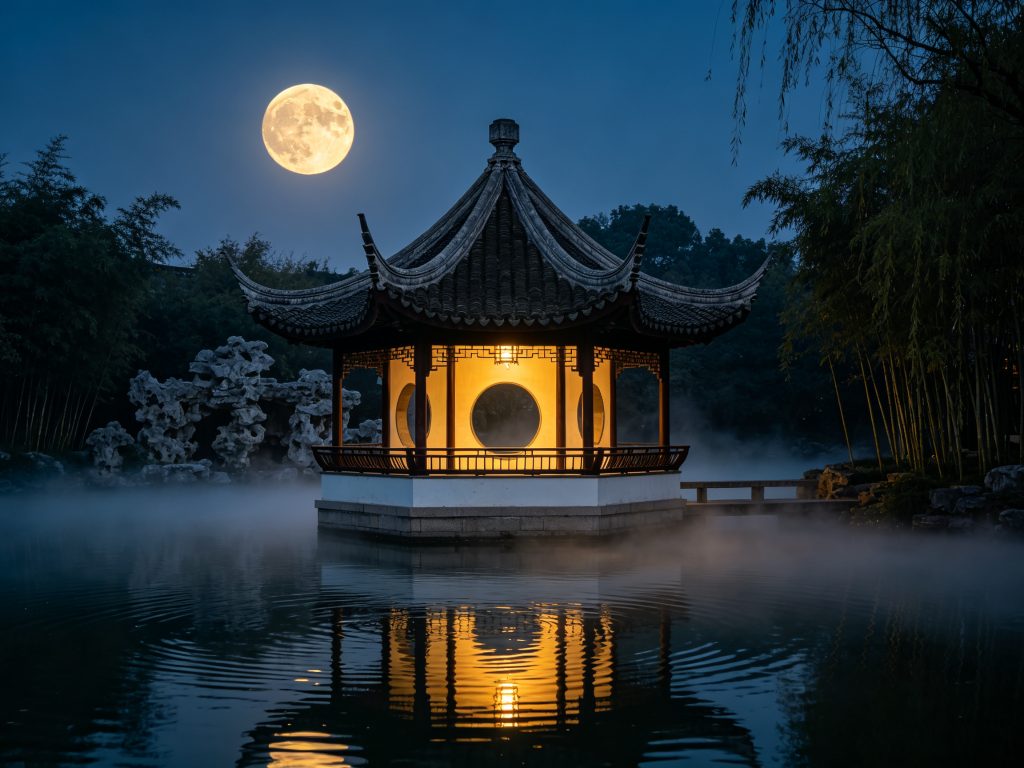
Chinese garden designers took this quiet practice and built houses for it. The most famous moon-watching pavilion in China is the Moon-Arriving and Wind-Coming Pavilion (月到风来亭) in the Master of the Nets Garden in Suzhou. It stands on the west bank of a small lake, three sides open to the water, and its name comes from a line by the Song-dynasty philosopher Shao Yong: “When the moon reaches the center of the sky, the wind comes over the surface of the water.”
The pavilion’s best trick is a large mirror set into its back wall. On a Mid-Autumn night, the visitor sees three moons at once: the real one overhead, its reflection in the lake, and a third inside the mirror. The garden covers only a few acres, yet it holds the entire sky. A pavilion is not shelter from the moon — it is a frame for it, a way of saying: sit here, do nothing, and let the night come to you. Its couplet reads: “The garden ripens when the wine is fresh; the courtyard opens wide when the moon is round.”
A Practice for This Year’s Full Moon
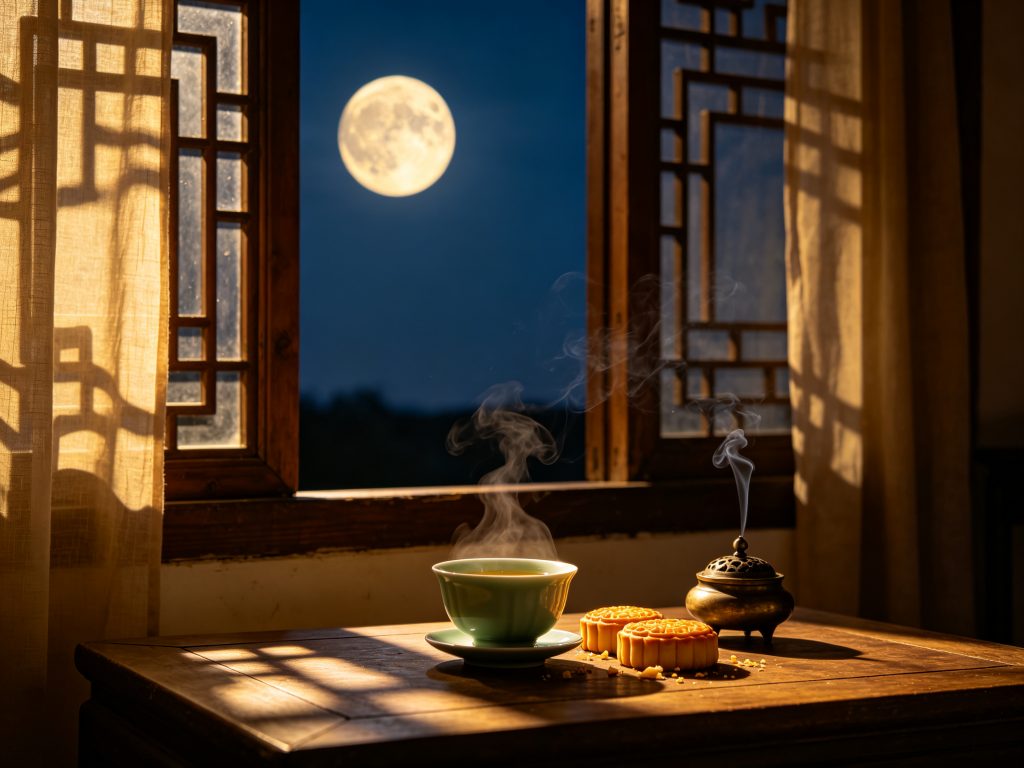
This year the Mid-Autumn Festival falls on September 25. Whatever your plans — a family dinner, a mooncake, a video call with someone far away — consider adding one quiet practice. Find a window, a balcony, or a park bench where the moon can reach you. Leave your phone inside. Sit for ten minutes and simply look. Watch how the moonlight moves across water or rooftops. Notice your thoughts arriving and leaving like clouds. And when a worry arrives — the month’s troubles, the people you miss — let the old line answer it: nothing has ever been perfect, and the moon is still beautiful.
You will be keeping the festival the way Su Shi did: not conquering the night, but sharing it.