Introduction
Peking Opera (Jingju), China’s most celebrated theatrical tradition, is renowned for its elaborate costumes, acrobatic combat, and highly stylized vocal performance. Yet one of its most fascinating and often misunderstood features is the tradition of cross-gender performance — actors portraying characters of the opposite sex. Far from a novelty or gimmick, this practice is deeply woven into the art form’s history, aesthetics, and philosophical outlook.
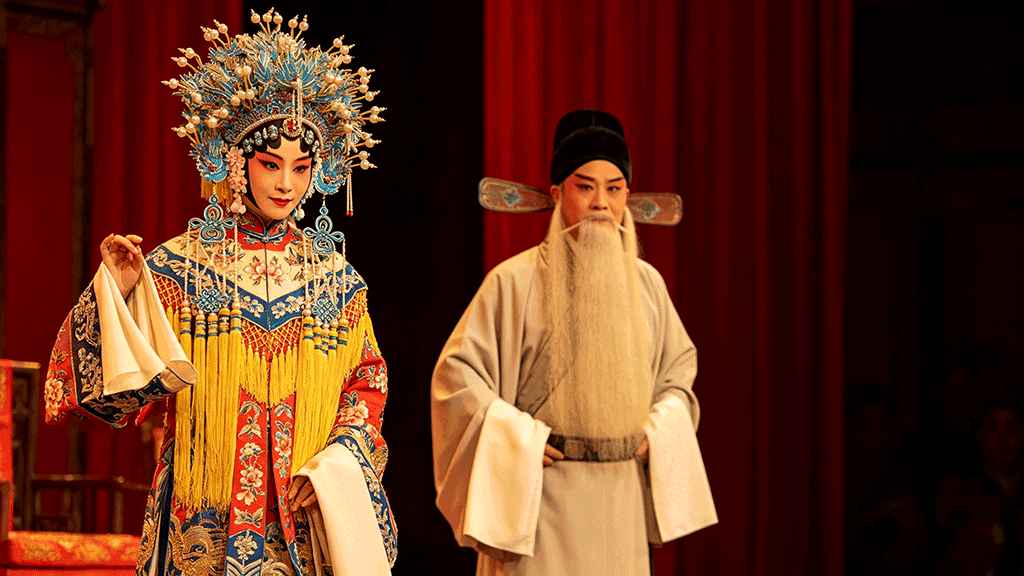
In Peking Opera, two terms define this phenomenon: Qian Dan (乾旦, “male Dan”) refers to male actors who perform female roles, while Kun Sheng (坤生, “female Sheng”) denotes female actors who perform male roles. A related concept, Fan Chuan (反串), describes an actor temporarily stepping outside their established role category — which may or may not involve crossing gender lines. Together, these practices reveal a theatrical culture in which gender is understood not as a biological given but as a performative craft, something to be studied, refined, and mastered.
Historical Origins: Why Men Played Women
The roots of male cross-gender performance in Peking Opera stretch back to the Qing Dynasty (1644–1911). During much of this period, imperial edicts and social conventions prohibited women from appearing on public stages. Female spectators were, at various times, also barred from attending performances. As a result, opera troupes were exclusively male, and every role — including the female characters collectively known as Dan (旦) — had to be performed by men.
This was not unique to Peking Opera. Similar restrictions existed across many regional Chinese theatrical forms. What set Peking Opera apart was the extraordinary artistic sophistication its male Dan performers achieved. Rather than merely imitating women, they developed a comprehensive system of vocal technique, gesture, gait, and facial expression that distilled feminine essence into a highly stylized, universally recognizable stage language.
By the late Qing and early Republican era (early 20th century), these restrictions gradually loosened. Women returned to the stage, and mixed-gender troupes became common. Yet the male Dan tradition had already become so central to Peking Opera’s identity that it not only survived but flourished, reaching its golden age in the 1920s and 1930s.
Qian Dan (Male Dan): The Four Great Dan Performers
The pinnacle of the male Dan tradition is embodied by the Si Da Ming Dan (四大名旦, “Four Great Dan Performers”), all of whom were men. They dominated the Peking Opera stage during the Republic era and each founded a distinct artistic school (pai, 派).

Mei Lanfang (1894–1961) — The Mei School
Widely regarded as the greatest Peking Opera performer of the 20th century, Mei Lanfang (梅兰芳) was the face of the male Dan tradition and a global cultural ambassador. Born into a theatrical family — his grandfather Mei Qiaoling was one of the “Thirteen Outstanding Performers of the Tongzhi-Guangxu Era” — Mei trained from childhood and made his stage debut at age eight.
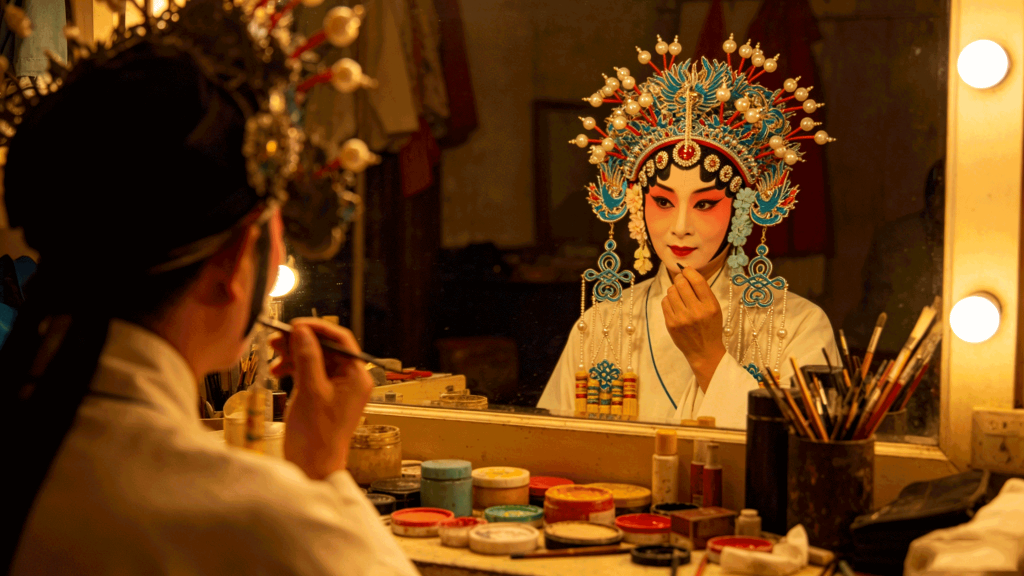
Mei’s art was characterized by elegance, balance, and naturalism. He reformed dan performance by integrating elements of Kunqu opera, refining makeup and costume design, and introducing more nuanced emotional expression. His signature roles include Consort Yang in The Drunken Concubine (Guifei Zuijiu) and Consort Yu in Farewell My Concubine (Bawang Bie Ji).
Crucially, Mei Lanfang was the first artist to bring Peking Opera to international audiences. He toured Japan (1919, 1924), the United States (1930), and the Soviet Union (1935), where his performances astonished Western theater practitioners — including Bertolt Brecht, who developed his theory of “alienation effect” partly in response to Mei’s art. In 1930, he received an honorary doctorate from the University of Southern California.
Cheng Yanqiu (1904–1958) — The Cheng School
Cheng Yanqiu (程砚秋) was celebrated for his haunting, melancholic vocal style — a technique described as “sobbing within song” (youye wanzhuan). His performances often centered on tragic, virtuous women facing adversity. The Cheng School remains one of the most widely practiced dan styles today, prized for its emotional depth and distinctive vocal ornamentation.
Shang Xiaoyun (1900–1976) — The Shang School
Shang Xiaoyun (尚小云) was known for his vigorous, martial energy and excelled in Daoma Dan (刀马旦) roles — warrior women such as Mu Guiying and Liang Hongyu. His style combined powerful vocals with dynamic stage movement, bringing a heroic dimension to female characterization.
Xun Huisheng (1900–1968) — The Xun School
Xun Huisheng (荀慧生) specialized in Hua Dan (花旦) roles — lively, witty young women, often from humble backgrounds. His performances were marked by naturalism, humor, and emotional accessibility, making him a favorite among popular audiences. He brought a sense of everyday humanity to characters who might otherwise have been treated as comic relief.
Kun Sheng (Female Sheng): Women Who Play Men
If the male Dan tradition is well known internationally, its mirror image — female actors performing male roles — is equally remarkable and far less celebrated outside China. These performers are called Kun Sheng (坤生), a term combining kun (坤, the feminine principle in the I Ching) with sheng (生, the male role category).
Meng Xiaodong (1908–1977): The “Winter King” of Laosheng
The most legendary Kun Sheng was Meng Xiaodong (孟小冬), known by her stage title “Dong Huang” (冬皇, “The Winter King”). In an era when women were still expected to perform dan roles, Meng made the radical choice to study Laosheng (老生, “old gentleman” or mature male role) — the most prestigious and demanding of all Peking Opera role types.
Meng became the leading disciple of Yu Shuyan (余叔岩), founder of the Yu School of laosheng, and was widely regarded as the finest exponent of Yu-style singing after her master’s death. Her voice was described as rich, powerful, and entirely convincing in male register — audiences reportedly forgot they were watching a woman.
Her personal life was equally dramatic. She briefly married Mei Lanfang (the greatest male Dan) in a union that captivated the public imagination — the quintessential female Sheng and male Dan, united in life as in art. The marriage ended in 1931, and Meng later married the Shanghai gangster-turned-patriot Du Yuesheng. Despite the turbulence of her personal life, her artistic legacy as the greatest Kun Sheng in Peking Opera history remains secure.
Other Notable Kun Sheng
- Xiao Lanying (筱兰英): An early Kun Sheng known for her powerful vocal delivery and commanding stage presence.
- En Xiaofeng (恩晓峰): A pioneering female laosheng who helped establish the artistic legitimacy of women performing male roles.
The Kun Sheng tradition challenged not only theatrical convention but also broader social expectations about gender. These women had to master a vocal range, physical posture, and behavioral code entirely different from those assigned to women in everyday life — and they had to do so convincingly enough to be accepted as male characters by audiences accustomed to male performers.
Fan Chuan (反串): Beyond Gender Crossing
A common misconception is that Fan Chuan (反串) simply means “cross-dressing” or “men playing women.” In fact, the term has a more precise meaning in Peking Opera terminology: it refers to an actor performing a role outside their primary role category (hangdang, 行当).
For example:
- A Dan actor (who normally plays female roles) performing a Sheng role is doing Fan Chuan — even though both roles might be performed by a man.
- A Laosheng performing a Jing (painted-face) role is also doing Fan Chuan.
- A male Dan performing a female role is not doing Fan Chuan — that is simply his ben gong (本工, “primary craft”).
Mei Lanfang himself was a celebrated Fan Chuan performer. Though his primary identity was Dan, he occasionally performed Xiaosheng (young male), Wusheng (martial male), and even Jing (painted-face) roles at charity galas and special performances. These appearances were highly anticipated because they showcased an actor’s versatility and technical range.
Thus, Fan Chuan is ultimately about artistic versatility rather than gender transgression. It reflects the Peking Opera ideal that a truly great performer should master multiple performance vocabularies.
The Aesthetics and Philosophy of Cross-Gender Performance
Why did cross-gender performance achieve such artistic heights in Peking Opera? The answer lies in the tradition’s core aesthetic principles.
Distillation Over Imitation
Peking Opera does not aim for realistic representation. Instead, it seeks to distill the essence of a character through codified movement, vocal technique, and symbolic gesture. A male Dan does not try to “be” a woman; he studies the essential qualities associated with femininity — grace, softness, emotional depth — and renders them through a refined artistic language. As Mei Lanfang observed, a male performer can sometimes achieve a more perfect distillation of feminine beauty precisely because he is not constrained by the literal reality of being a woman.
Similarly, a Kun Sheng does not merely dress as a man; she cultivates the bearing, vocal weight, and moral gravity associated with the Sheng role — qualities that transcend biological sex.
Gender as Performance
Long before Western theory articulated the concept of gender as performativity, Peking Opera treated gender as a craft to be learned and executed. The stage was a space where the boundary between male and female became fluid — not to challenge social norms, but to demonstrate that artistic truth operates on a level beyond biological distinction. A great performance convinces not because the actor resembles the character’s sex, but because the actor embodies the character’s spirit (shen, 神).
The Yin-Yang Principle
This fluidity resonates with the traditional Chinese philosophical concept of Yin and Yang — the complementary, interdependent principles of feminine and masculine, darkness and light, softness and hardness. In the I Ching, neither principle exists in pure form; each contains the seed of the other. Cross-gender performance in Peking Opera can be seen as a theatrical expression of this idea: the male contains the feminine (Yin within Yang), and the female contains the masculine (Yang within Yin).
Legacy and Contemporary Status
After the founding of the People’s Republic of China in 1949, the male Dan tradition faced periods of official ambivalence. During the Cultural Revolution (1966–1976), it was largely suppressed as “feudal” or “decadent.” Since the reform era began in the late 1970s, older male Dan performers returned to the stage, and the tradition has experienced a gradual revival, though it remains a specialized niche within the Peking Opera world.
The Kun Sheng tradition, by contrast, has been more continuously accepted. Female performers of male roles are a regular and respected presence in contemporary Peking Opera, with several prominent artists carrying forward the legacy of Meng Xiaodong.
Fan Chuan remains a beloved feature of gala performances and special occasions, allowing audiences to see beloved performers in unexpected roles.
Conclusion
Cross-gender performance in Peking Opera is far more than a historical curiosity or a footnote to theatrical history. It is a core expression of the art form’s aesthetic philosophy — a demonstration that gender, like every other element of the Peking Opera stage, is not a fixed reality but a language to be mastered, transformed, and transcended in the pursuit of artistic truth.
From Mei Lanfang’s global triumphs to Meng Xiaodong’s reign as the “Winter King,” from the rigorous training of the Four Great Dan to the playful versatility of Fan Chuan, this tradition invites us to see the stage not as a mirror of society but as a space where the human spirit — beyond categories of male and female — finds its most complete expression.
For more articles on Chinese traditional arts and culture, explore our collection at ccpark.com.