Part of the “Festivals & Traditions” series — how China marks time by the sky · Reading time: 5 minutes
A Calendar Written by Nature
Sometime in early September — usually the 7th or 8th — China crosses an invisible line. The date appears in every Chinese calendar, on every phone, and in the minds of farmers, tea drinkers, and grandmothers: it is Bailu (白露), White Dew, the fifteenth of the twenty-four solar terms (节气,jiéqì).
The 24 solar terms are one of the oldest and most elegant time systems on earth. Around two thousand years ago, Chinese astronomers divided the sun’s annual journey into twenty-four equal segments of about fifteen days, and named each one after what nature was doing at that moment: Insects Awaken, Grain Rain, Start of Winter, White Dew. This is neither a lunar calendar nor quite a solar one — it is a calendar written by nature itself, telling a people when to plant, when to harvest, when to wear more clothes, and when to drink a particular cup of tea. In 2016, UNESCO inscribed the 24 solar terms on its list of Intangible Cultural Heritage of Humanity, recognizing them as “knowledge in China of time and practices developed through observation of the sun’s annual motion.”
Every Chinese child learns them through a song:
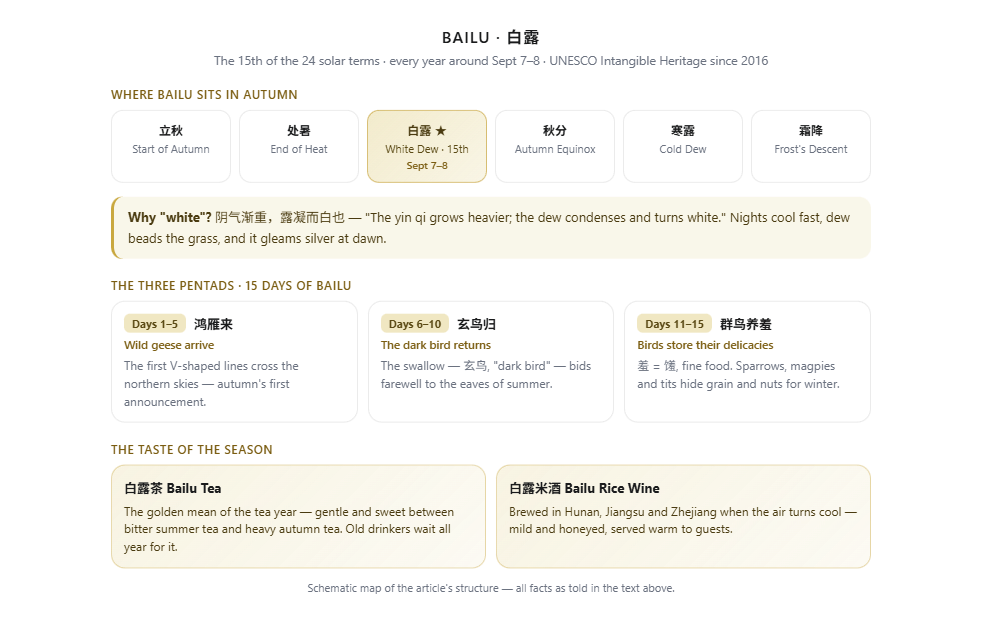
春雨惊春清谷天,夏满芒夏暑相连, 秋处露秋寒霜降,冬雪雪冬小大寒。
Spring rain, spring equinox, clear-and-bright, grain rain; summer full, summer grain, heat upon heat; autumn, heat’s end, dew, autumn equinox, cold dew, frost’s descent; winter snow, winter solstice, minor and major cold.
And if you ask which term has the most beautiful name, nobody argues: it is White Dew.
Why Is the Dew “White”?
The name is pure physics, wrapped in poetry. By White Dew, the sun has grown low and weak; the nights turn cool while the days stay warm. The gap between day and night temperatures can reach ten degrees or more in northern China. As the ground radiates away its heat after sunset, water vapor condenses into thousands of tiny droplets on grass, leaves, and windowsills. By dawn, the fields are beaded with moisture — and in the low morning light, that dew looks white and silver, as if autumn had sprinkled frost before its time.
The classic Collected Explanations of the Seventy-Two Pentads (《月令七十二候集解》) puts it simply: 阴气渐重,露凝而白也 — “The yin qi grows heavier; the dew condenses and turns white.”
Farmers have a proverb for what comes next: 白露秋分夜,一夜凉一夜 — “After White Dew, night by night it grows colder.” And grandmothers warn: 白露身不露 — “At White Dew, don’t leave your body uncovered.” This is the first true Chinese autumn solar term: by nine in the evening, summer’s last warmth is a lie.
The Three Pentads of White Dew
Chinese tradition divides each solar term into three pentads (候,hòu) of five days each, and gives every pentad its own sign of the season. White Dew’s three signs tell a quiet migration story:
- 一候鸿雁来 — Wild geese arrive. The first geese from the north fly south in their long V-shaped lines, crossing the skies of northern China. Their calls are autumn’s first announcement.
- 二候玄鸟归 — The dark bird returns. Xuánniǎo, “the dark bird,” is the swallow, which tradition says came from the south. Now it goes back — a farewell to the eaves of summer.
- 三候群鸟养羞 — Birds store their delicacies. 羞 (xiū) is an old form of 馐 (xiū), “fine food.” Sparrows, magpies, and tits begin hiding grain, nuts, and seeds for the lean months ahead.
Read together, the three pentads form one sentence: the guests of summer are leaving, and those who stay are preparing. Even without a weather forecast, the sky itself tells you autumn has begun.
What to Eat and Drink: Bailu Tea & Bailu Rice Wine
Because the solar terms were born in the fields, they come with their own table. White Dew has two famous companions.
Bailu Tea (白露茶). Tea growers know a leaf’s character changes week by week. Summer tea is harsh and bitter; the tea of late autumn is thick and heavy. But the tea picked in the few weeks around White Dew — báilù chá — is the golden mean: gentle, sweet, with a clean, lingering aftertaste. Old tea drinkers wait all year for it, and the first pot is said to taste of the season itself: cool mornings, ripe grain, and the last of the sun.
Bailu Rice Wine (白露米酒). In Hunan, Jiangsu, and Zhejiang, households brew sweet rice wine when White Dew arrives, letting sticky rice ferment slowly in the cool air. The result is a mild, honeyed drink, served warm to guests — a taste of old village hospitality that city shops now bottle as a seasonal luxury.
A few regions add their own customs: in Fuzhou, families eat longan (龙眼,lóngyǎn) on White Dew morning, believing the fruit is at its sweetest; in the north, it is the season for fresh dates. Whatever the local treat, the logic is the same: eat what the season is giving you, while it is giving it.
A Rhythm Chinese People Still Keep
Here is the strange magic of the 24 solar terms: in an age of weather apps and climate models, hundreds of millions of Chinese people still live by them. Farmers still time their harvests to them. Tea shops still label their best leaves with them. Restaurants still name autumn menus after them. And elderly relatives still text you at Bailu: don’t walk barefoot; cover up at night.
The solar terms survive because they are not superstition — they are rhythm. They tell a people who have lived on the same land for millennia exactly where they are in the turning of the year. No clock needed. Just look at the dew on the grass at dawn: if it is white and cold, autumn has arrived.
And right on cue, the most famous night of the Chinese autumn is only days away. The full moon of Mid-Autumn is rising — and in our last article, we told you what it means.
This article is part of the “Festivals & Traditions” series. Next: Autumn Equinox (秋分) — the day China balances day and night, and the harvest festivals begin.