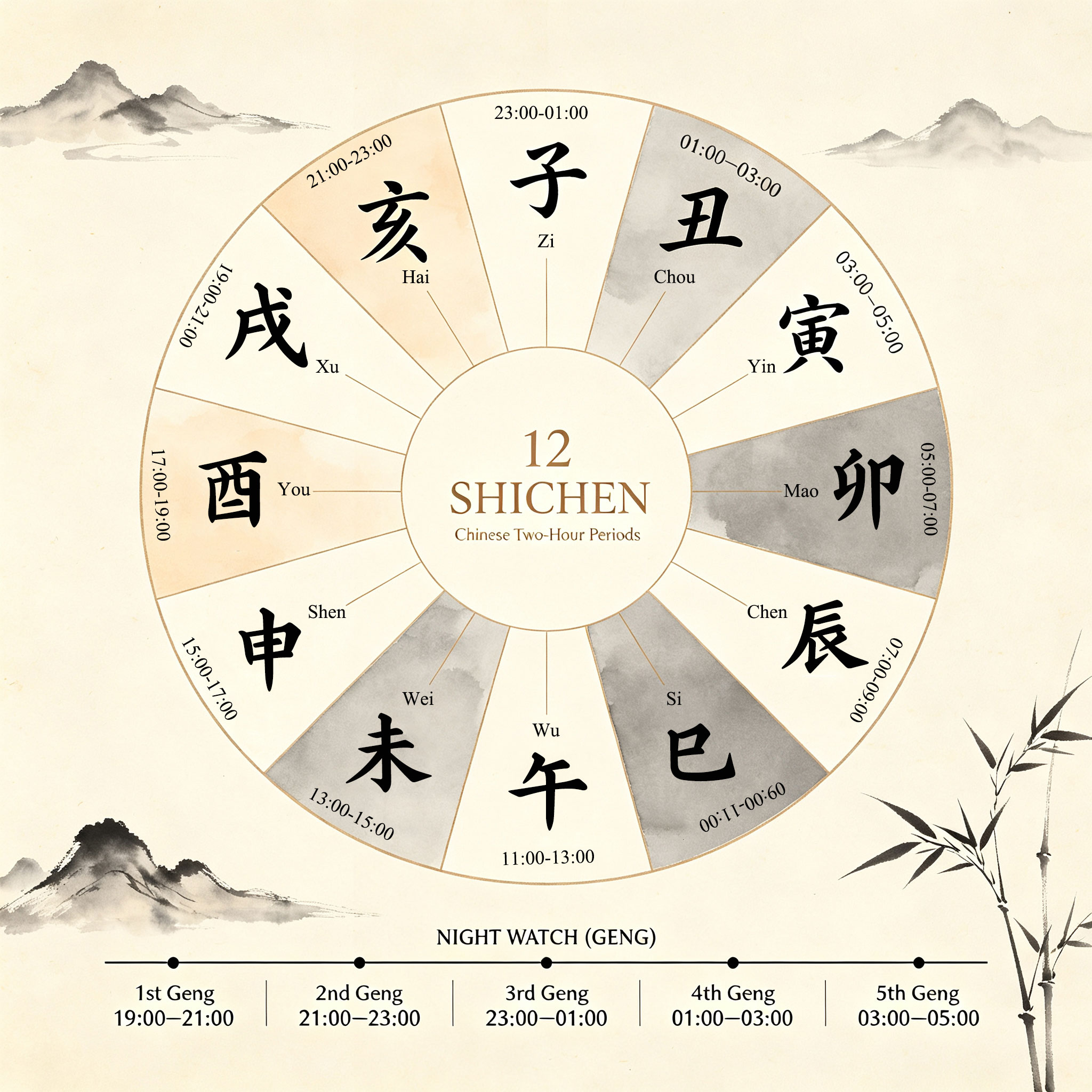
A comprehensive guide to how ancient China measured time — from the twelve shichen double-hours to the five night watches and the quarter-hour ke system that shaped a civilization’s daily rhythm.
Introduction: How Did Ancient China Tell Time?
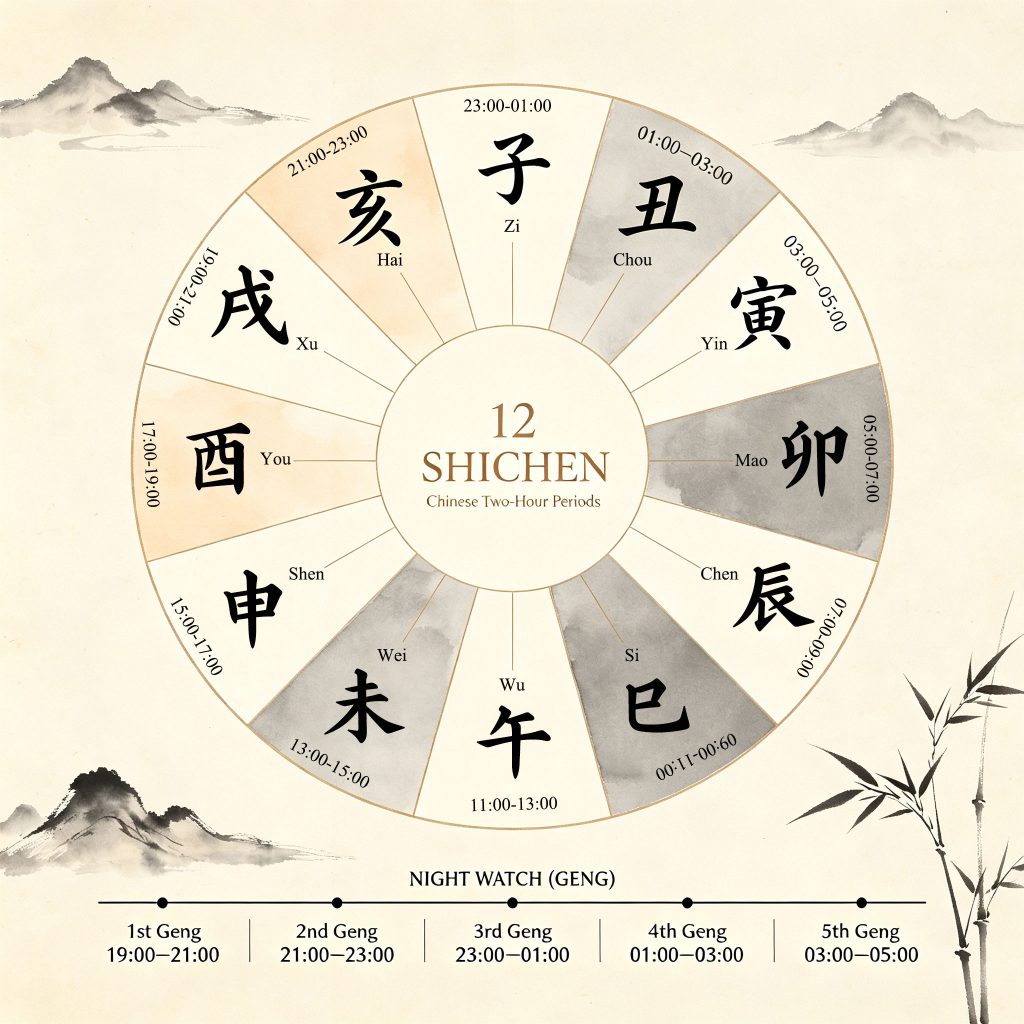
Long before mechanical clocks reached East Asia, the Chinese had already developed a sophisticated, multi-layered system for dividing the day. Unlike the modern 24-hour clock, which splits day and night into equal hours, ancient Chinese timekeeping was rooted in astronomy, agriculture, and the rhythms of natural light. The system combined several complementary units: the twelve earthly branches (shichen), the night watch (geng), the quarter-mark (ke), and the point (dian). Together, they formed a precise and culturally rich framework that governed everything from imperial court ceremonies to agricultural labor and neighborhood curfews.
Understanding these units is essential not only for historians but for anyone reading classical Chinese literature, watching period dramas, or exploring traditional culture. References to “the third watch” or “the three ke of the noon hour” appear constantly — and they are almost always misunderstood by modern readers. This article breaks down each unit with clear conversion tables, clarifies the most common misconception about the noon hour, and explains why these ancient measures still matter today.
The Twelve Earthly Branches (Shichen): A Day in Twelve Double-Hours
The foundation of ancient Chinese timekeeping is the system of twelve earthly branches (十二地支, shí’èr dìzhī). Each branch corresponds to a two-hour period, called a shichen (时辰), making a full day of 24 hours. The system is at least two thousand years old and was originally tied to the position of the sun and the constellations along the ecliptic.
The twelve branches — Zi, Chou, Yin, Mao, Chen, Si, Wu, Wei, Shen, You, Xu, Hai — are also associated with the twelve zodiac animals, a connection familiar to many through the Chinese New Year cycle. In timekeeping, however, their primary function is to mark fixed two-hour windows throughout the day and night.
Key Feature: The Day Begins at Zi Shi (23:00)
A critical difference from the Western clock: the Chinese day does not begin at midnight (00:00). It begins at Zi Shi (子时), which runs from 23:00 to 01:00. This means the “midnight hour” straddles two calendar dates in the Western sense — a detail that has caused confusion in historical chronology for centuries. In traditional Chinese astrology and divination, the moment of 23:00 marks the start of a new day, not 00:00.
Complete 12 Shichen Conversion Table
| Branch | Pinyin | Zodiac Animal | Modern Time | Traditional Association |
|---|---|---|---|---|
| 子 | Zi | Rat | 23:00 – 01:00 | Deepest night; new day begins |
| 丑 | Chou | Ox | 01:00 – 03:00 | Oxen begin to chew cud |
| 寅 | Yin | Tiger | 03:00 – 05:00 | Tigers hunt most fiercely |
| 卯 | Mao | Rabbit | 05:00 – 07:00 | Sunrise; rabbits emerge |
| 辰 | Chen | Dragon | 07:00 – 09:00 | Dragons stir in the morning mist |
| 巳 | Si | Snake | 09:00 – 11:00 | Snakes leave their burrows |
| 午 | Wu | Horse | 11:00 – 13:00 | Solar noon; horses gallop |
| 未 | Wei | Goat | 13:00 – 15:00 | Goats graze in afternoon |
| 申 | Shen | Monkey | 15:00 – 17:00 | Monkeys become active |
| 酉 | You | Rooster | 17:00 – 19:00 | Sunset; roosters return to roost |
| 戌 | Xu | Dog | 19:00 – 21:00 | Dogs begin night watch |
| 亥 | Hai | Pig | 21:00 – 23:00 | Pigs sleep deeply; day ends |
Each shichen was further subdivided into an “initial” (初, chū) and “central” (正, zhèng) half, each lasting one hour. For example, Wu Chu (午初) was 11:00–12:00, and Wu Zheng (午正) was 12:00–13:00. This refinement, introduced during the Song dynasty, made the system compatible with the Western 24-hour concept when Jesuit missionaries later introduced European astronomy to China.
The Night Watch System (Geng): Time After Dark
While the twelve shichen covered the entire day, a separate system called geng (更) was used exclusively during the night. The night watch system was practical: in an era without streetlights, knowing the time at night was a matter of safety, curfew enforcement, and religious ritual. Professional night watchmen (更夫, gēngfū) patrolled cities and villages, striking a wooden clapper (梆子, bāngzi) or gong to announce each watch.
A geng lasted exactly two hours — the same length as a shichen — but the system only ran from dusk to dawn, covering five watches in total. The first watch began at Xu Shi (19:00–21:00), and the fifth and final watch ended at Yin Shi (03:00–05:00), just before dawn.
Complete Night Watch (Geng) Conversion Table
| Watch | Chinese | Modern Time | Shichen | Cultural Note |
|---|---|---|---|---|
| 1st Geng (一更) | Yì Gēng | 19:00 – 21:00 | Xu Shi (戌时) | “Dusk watch” — families settle in, city gates close |
| 2nd Geng (二更) | Èr Gēng | 21:00 – 23:00 | Hai Shi (亥时) | “Night watch” — most people asleep |
| 3rd Geng (三更) | Sān Gēng | 23:00 – 01:00 | Zi Shi (子时) | “Midnight watch” — deepest night; ghosts and spirits active in folklore |
| 4th Geng (四更) | Sì Gēng | 01:00 – 03:00 | Chou Shi (丑时) | “Pre-dawn watch” — thieves and nocturnal animals stir |
| 5th Geng (五更) | Wǔ Gēng | 03:00 – 05:00 | Yin Shi (寅时) | “Dawn watch” — roosters crow, monks rise for morning chanting |
The third watch (三更, sān gēng), corresponding to midnight, is the most culturally significant. In classical Chinese literature and folklore, the “third watch” is the hour when the boundary between the living and the spirit world thins. Ghost stories, supernatural encounters, and secret meetings are almost always set at this hour. The phrase “三更半夜” (sān gēng bàn yè), meaning “the middle of the night,” remains a common idiom in modern Chinese.
It is worth noting that the geng system was strictly a nighttime measure. During daylight hours, time was told using the shichen and ke systems, often with the aid of sundials (日晷, rìguǐ) and water clocks (漏刻, lòukè).
The Ke (刻) System: Quarter-Hour Precision
For more precise time measurement, the Chinese used a unit called ke (刻), literally meaning “mark” or “engraving.” The ke system has a long and evolving history. In early imperial times, a day was divided into 100 ke, making each ke approximately 14.4 minutes — an awkward number that did not align cleanly with the twelve shichen.
During the Ming and Qing dynasties (14th–20th centuries), the system was reformed to 96 ke per day. This was a deliberate adjustment to make the ke compatible with the shichen: since 96 ÷ 12 = 8, each shichen now contained exactly 8 ke. With 96 ke in 24 hours, one ke equals precisely 15 minutes — the same as a modern “quarter hour.” This coincidence is not accidental; it reflects the global convergence of timekeeping standards during the early modern period.
Ke Conversion Summary
| Unit | Equivalent | Modern Equivalent |
|---|---|---|
| 1 day | 96 ke (post-Ming) | 24 hours |
| 1 shichen | 8 ke | 2 hours |
| 1 ke | — | 15 minutes |
The ke was typically counted within each shichen. For example, “the third ke of the noon hour” (午时三刻, wǔ shí sān kè) means the third 15-minute mark after the start of Wu Shi. This leads us to one of the most widespread misconceptions in Chinese timekeeping.
The “Noon Three Ke” Misconception: It Is NOT 12:00 Noon
Common Mistake: Many people — including some modern Chinese speakers — assume that “午时三刻” (Wu Shi San Ke, “the third ke of the noon hour”) refers to 12:00 noon or 12:45. This is incorrect.
Let us work through the math carefully. Wu Shi (午时) runs from 11:00 to 13:00. It contains 8 ke, each 15 minutes long:
- 1st ke (一刻): 11:00 – 11:15
- 2nd ke (二刻): 11:15 – 11:30
- 3rd ke (三刻): 11:30 – 11:45
- 4th ke (四刻): 11:45 – 12:00
- 5th ke (五刻): 12:00 – 12:15
- 6th ke (六刻): 12:15 – 12:30
- 7th ke (七刻): 12:30 – 12:45
- 8th ke (八刻): 12:45 – 13:00
Therefore, “午时三刻” refers to 11:30 – 11:45, not 12:00 noon and not 12:45. The true solar noon (12:00) falls at the boundary between the 4th and 5th ke of Wu Shi — sometimes called “午正” (Wu Zheng, “central noon”).
This distinction matters enormously in historical and legal contexts. In imperial China, executions were traditionally scheduled at “午时三刻” (11:30–11:45), not at high noon. The reasoning was both practical and symbolic: the sun was near its zenith, making the shadow shortest, and the yang energy was considered strongest — believed to counteract the yin influence of death. Many period dramas and novels incorrectly stage these scenes at exactly 12:00, perpetuating the confusion.
A useful mnemonic: when you see “三刻” (three ke), think “three quarter-hours past the start of the hour.” Since Wu Shi starts at 11:00, three ke = 45 minutes later = 11:45 (the end of the third ke period).
The Dian (点): Subdividing the Night Watch
Within the night watch system, an even finer unit was used: the dian (点), meaning “point” or “dot.” Each geng (watch) was divided into 5 dian. Since a geng lasts 2 hours (120 minutes), each dian equals 24 minutes.
The dian allowed night watchmen and officials to specify time more precisely within a watch. For example, “the third dian of the fourth watch” (四更三点, sì gēng sān diǎn) would be calculated as: 4th watch starts at 01:00, plus 3 × 24 minutes = 72 minutes, placing it at approximately 02:12.
Dian Conversion Summary
| Unit | Equivalent | Modern Equivalent |
|---|---|---|
| 1 geng (watch) | 5 dian | 2 hours (120 min) |
| 1 dian | — | 24 minutes |
The dian was primarily a nighttime unit, used alongside the geng system. During the day, the ke (15 minutes) served the same subdividing function within the shichen. The existence of two parallel sub-unit systems — ke for daytime, dian for nighttime — reflects the fundamentally different social rhythms of day and night in pre-modern China.
How the Units Work Together: A Complete Picture
To understand ancient Chinese timekeeping fully, it helps to see how all four units interlock:
| Unit | Chinese | Coverage | Duration | Sub-units |
|---|---|---|---|---|
| Shichen | 时辰 | Full day (12 total) | 2 hours | 8 ke each |
| Geng | 更 | Night only (5 total) | 2 hours | 5 dian each |
| Ke | 刻 | Daytime precision | 15 minutes | — |
| Dian | 点 | Nighttime precision | 24 minutes | — |
During the day, a person might say “it is the third ke of the Chen hour” (辰时三刻) — meaning approximately 07:45. At night, they would instead say “it is the second dian of the third watch” (三更二点) — meaning approximately 23:48. The choice of system itself conveyed whether it was day or night, adding an extra layer of information that the modern 24-hour clock lacks.
Cultural Significance and Legacy
The ancient Chinese timekeeping system is far more than a historical curiosity. It shaped the language, literature, and daily rituals of Chinese civilization in ways that persist to this day.
In language: Modern Chinese still uses the word “shichen” (时辰) colloquially to mean “time” or “a while,” though it no longer refers to the specific two-hour unit. The idiom “三更半夜” (midnight) and the expression “午时三刻” remain in common use, even by speakers who may not know their precise historical meaning.
In literature and drama: Countless classical poems, novels, and plays reference specific shichen or geng to set mood and atmosphere. The “third watch” signals mystery and danger; the “fifth watch” signals diligence and awakening. Understanding these references deepens the reading experience enormously.
In astrology and feng shui: The twelve shichen remain fundamental to Chinese astrology (八字, bāzì), where the hour of birth — expressed as an earthly branch — is one of the four “pillars” that determine a person’s destiny. The fact that the day begins at 23:00 (Zi Shi) rather than 00:00 remains a critical detail in astrological calculations.
In modern culture: The 24-hour solar terms (节气), traditional medicine’s meridian flow charts (which map organ systems to specific shichen), and even contemporary wellness trends all draw on this ancient temporal framework.
Conclusion
Ancient Chinese timekeeping was a remarkably sophisticated system that combined astronomical precision with cultural meaning. The twelve shichen divided the day into meaningful two-hour segments, each associated with a zodiac animal and natural phenomenon. The five geng watches governed the night with practical precision, while the ke and dian units provided quarter-hour and 24-minute granularity for day and night respectively.
The most important takeaway for modern readers is this: the Chinese day begins at 23:00, not midnight; “午时三刻” means 11:30–11:45, not 12:00 noon; and the night watch system operated independently from the daytime shichen system. Keeping these distinctions in mind will unlock countless references in Chinese history, literature, and culture — and perhaps change the way you think about time itself.
Keywords: ancient Chinese timekeeping, 12 earthly branches, Chinese shichen, night watch system, Chinese ke time unit, geng system, dian, wushi sanke, traditional Chinese hours