Meta Description
Discover the ancient Chinese 12 time periods, accurate modern 24-hour time conversions, and classic traditional Chinese timekeeping system. Explore the unique oriental cultural wisdom and ancient time calculation rules behind this traditional chronological system.
Core Keywords
Ancient Chinese 12 time periods, traditional Chinese timekeeping system, ancient Chinese time calculation rules
Introduction
Long before mechanical clocks and digital timers dominated daily life, ancient Chinese civilizations developed an intricate, self-contained traditional Chinese timekeeping system. Rooted in astronomical observations, solar and lunar cycles, and natural day-night transitions, the iconic ancient Chinese 12 time periods system standardized time measurement across China for thousands of years.

More than a mere chronological tool, this ancient Chinese time calculation framework integrates traditional astronomy, agricultural lifestyles, oriental philosophy, and folk customs. Embracing the core principle of “harmony between humanity and nature”, it regulated ancient people’s work, rest, rituals, and daily routines. This guide thoroughly explains the core rules of the ancient Chinese 12 time periods, their precise modern time equivalents, and all classic traditional timekeeping methods for cultural enthusiasts.
1. Basic Rules of Ancient Chinese Timekeeping
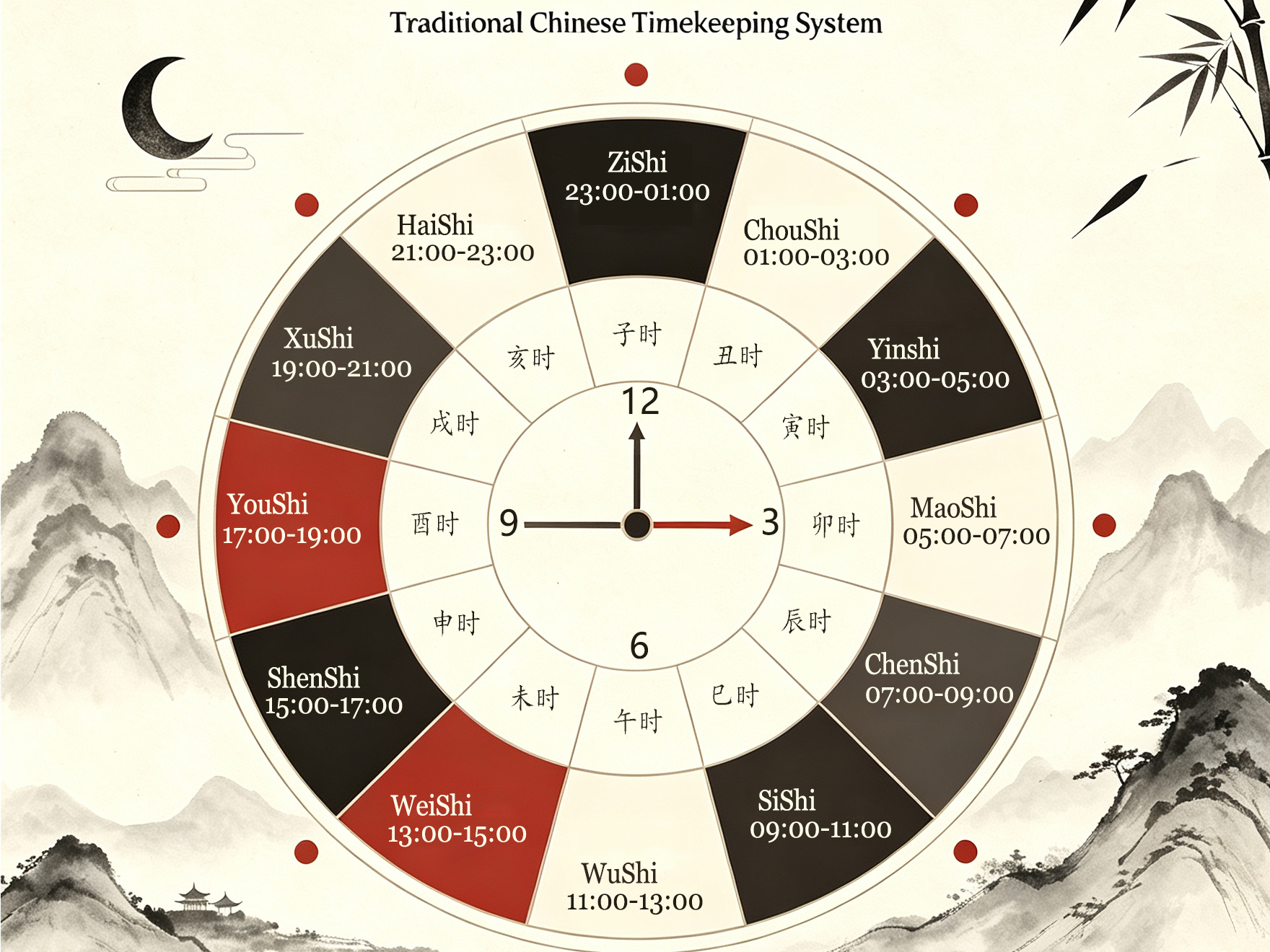
While modern society uses a 24-hour timeline, the traditional Chinese timekeeping system divides a full day and night into 12 unique time periods, with each single ancient time unit equivalent to two modern hours.
The twelve periods are named after the Twelve Earthly Branches: Zi, Chou, Yin, Mao, Chen, Si, Wu, Wei, Shen, You, Xu, Hai. These twelve units circulate continuously to record time.
The most distinct difference between ancient and modern time calculation lies in the start of a new day. A modern day begins at 00:00, while a traditional Chinese day starts with Zi Shi (23:00–01:00). Ancient people further categorized each day into four natural phases: midnight, dawn, daytime, and dusk, creating a time system perfectly aligned with natural light rhythms.
2. 12 Ancient Chinese Time Periods & Modern Time Comparison
Each time period has a fixed time range, a traditional poetic name, and unique lifestyle implications, reflecting ancient people’s regular daily rhythms:

1. Zi Shi (23:00 – 01:00) | Midnight As the first segment of the ancient Chinese 12 time periods cycle, Zi Shi marks the transition of Yin and Yang cosmic energy. The world falls into complete silence, making it the ideal time for deep rest and physical and mental restoration for ancient people.
2. Chou Shi (01:00 – 03:00) | Cock Crow This is the darkest window before dawn. Roosters crow to signal the upcoming sunrise. Farmers and craftsmen began preparing tools and supplies for the next day’s labor, while night watchmen patrolled to maintain public order during this quiet period.
3. Yin Shi (03:00 – 05:00) | Dawn Break A transitional period bridging night and day, when the sky gradually glows faintly bright. In ancient times, court officials prepared for early morning assemblies, and traveling merchants set off at this peaceful dawn hour to start their journeys.
4. Mao Shi (05:00 – 07:00) | Sunrise The sun fully rises, awakening all living creatures. Ancient people completed morning washing and grooming, officially starting their daily routines. Government offices opened for business, and urban markets began daily trading activities.
5. Chen Shi (07:00 – 09:00) | Breakfast Hour The fixed breakfast time in ancient China. After sunrise, people took meals to store energy for farming, studying, craftsmanship, and daily labor.
6. Si Shi (09:00 – 11:00) | Late Morning The sun climbs high with gentle and bright daylight. This was the most efficient time for ancient people to work, study, weave cloth, and cultivate fields.
7. Wu Shi (11:00 – 13:00) | Noon The sun reaches its zenith, bringing vigorous Yang energy. Following traditional Yin-Yang balance philosophy, ancient people avoided strenuous labor at noon and took a short nap to regulate physical energy and maintain bodily harmony.
8. Wei Shi (13:00 – 15:00) | Early Afternoon The sun gradually tilts westward, and intense summer heat fades. After a short rest, people continued working, trading, and studying.
9. Shen Shi (15:00 – 17:00) | Late Afternoon Meal Time Soft warm light covers the land. Farmers finished most field work, scholars practiced calligraphy and reading, and artisans focused on delicate craftsmanship before sunset.
10. You Shi (17:00 – 19:00) | Sunset Dusk arrives, and daylight fades. Workers returned home, markets closed, and social activities ceased, marking the end of the daytime working period.
11. Xu Shi (19:00 – 21:00) | Twilight The sky turns dim and quiet. Ancient people lit lamps for reading, family chatting, and daily reflection, enjoying peaceful leisure time.
12. Hai Shi (21:00 – 23:00) | Rest Hour The whole world settles down. All work stops completely. Ancient people prepared for sleep to conserve energy for the new cycle.
3. Core Traditional Chinese Timekeeping Systems
Beyond the foundational ancient Chinese 12 time periods framework, ancient Chinese scholars and officials developed three supplementary professional timekeeping methods. These layered systems covered civilian daily life, official administration, astronomical research, and night patrol management, forming a complete traditional Chinese timekeeping system.
3.1 Twelve Branches Period Timing (Daily Civilian Standard)
This is the most popular and long-used timekeeping method in ancient China. Using twelve Earthly Branch names plus poetic natural aliases, it was simple, vivid, and easy for ordinary people to understand. It was widely used in daily conversations, ancient books, poems, folk customs, and traditional records.
3.2 Hundred-Ke Time System (Official Precise Timing)
Since each two-hour time period was too general for official rituals and astronomical records, ancient officials created the Ke (moment) precision unit.
In early ancient times, one full day was divided into 100 Ke. Later, it was adjusted to 96 Ke per day to perfectly match the 12 periods, which was finalized in the Ming and Qing dynasties.
Under the standardized 96-Ke system adopted in ancient China, 1 Ke equals 15 modern minutes, and one full ancient time period contains 8 Ke. The well-known historical phrase “executing criminals at the third Ke of noon” refers precisely to 11:45, representing the highest precision of ancient Chinese time calculation for official ritual and judicial affairs.
3.3 Geng-Dian Night Timing (Exclusive Night System)
Without sunlight at night, it was difficult to judge time accurately. Therefore, ancient people invented the Geng-Dian system specially for night time management and security patrols, announced by night watchmen.
The night time range spans from Xu Shi (19:00) to Yin Shi (05:00), divided into five Gengs, with each Geng lasting two hours:
First Geng (Twilight), Second Geng (Quiet Night), Third Geng (Midnight), Fourth Geng (Cock Crow), Fifth Geng (Dawn).
The popular idiom “deep in the third night” exactly refers to the midnight Zi Shi (23:00–01:00). Each Geng is further divided into five Dian, with one Dian roughly equal to 24 minutes, realizing refined night time recording.
3.4 Sundial Shadow Timing (Original Astronomical Benchmark)
This is the earliest timekeeping method in ancient China and the foundation of all later systems. The core tool is the sundial, which judges time by observing the length and direction of sunlight shadows.
Ancient people could also estimate general time by observing sunrise, sunset, and star constellation positions. Though lacking precise numerical accuracy, this original method strictly followed natural cosmic rhythms, embodying the core oriental philosophy of conforming to nature that underpins all traditional Chinese timekeeping systems.
4. Cultural Connotation: Ancient vs. Modern Time Concepts
Modern 24-hour time is a globally unified, mechanical standard focused solely on precise numerical calibration. In stark contrast, the ancient Chinese 12 time periods system is a human-centric, culturally rich philosophy built on harmony between humans and nature.
Ancient Chinese time was not defined by cold numbers, but integrated with solar changes, seasonal cycles, human body rhythms, and traditional etiquette. It formed a regular lifestyle of “working at sunrise and resting at sunset”.
This unique time view carries thousands of years of Chinese life wisdom, traditional medicine health concepts, and ritual culture, becoming an important part of oriental aesthetics and natural philosophy.
Conclusion
The ancient Chinese 12 time periods and their supporting professional timekeeping methods form a rigorous, humanized, and aesthetically unique traditional chronological civilization. Every time segment corresponds perfectly to natural environmental changes and human daily behaviors, blending practical functionality, oriental aesthetics, and profound natural philosophy.
Unlike the rigid, one-size-fits-all standard of modern time calculation, the traditional Chinese timekeeping system prioritizes natural rhythm, physical balance, and harmony with the universe. This timeless oriental cultural wisdom continues to inspire modern slow-living lifestyles, minimalist home aesthetics, and oriental cultural design creation.
Keyword Recap
Ancient Chinese 12 time periods, traditional Chinese timekeeping system, ancient Chinese time calculation rules