1. How Many Common Types of Peking‑Opera Facial Masks Are There
Traditional Peking‑opera face painting, also named Lianpu, has six classic fundamental patterns, plus hundreds of derived variant designs. Around 100 frequently‑used classic masks are adopted in daily opera performances.
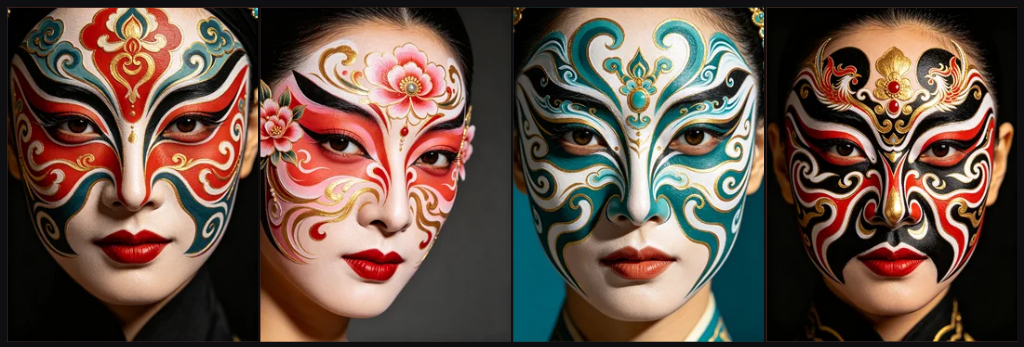
- Whole‑face Mask (Zheng Lian) One dominant base colour covers the full face, with only outlined eyebrows and eye sockets. Famous examples are the red‑faced Guan Yu and black‑faced Judge Bao.
- Three‑tile Face (San Kuai Wa Lian) The facial layout is split into three colour sections. It ranks among the most‑common 谱式 for fierce warrior characters.
- Cross‑shaped Face (Shi Zi Men Lian) One vertical stripe stretches over the forehead while two horizontal stripes cross the eye sockets, forming a cross mark. Zhang Fei is its iconic character.
- Scattered‑pattern Face (Sui Hua Lian) Dense, irregular decorative patterns cover the whole face, designed for unrestrained, bold outlaws.
- Asymmetrical Crooked Face (Wai Lian) Left‑right unbalanced facial markings stand for twisted‑minded villains or disfigured fighters.
- Ingot‑shaped Face (Yuan Bao Lian) Its forehead pattern takes the outline of a traditional Chinese gold ingot.
2. Colour Symbolism Rules for Peking Opera Lianpu

Every mask colour carries fixed symbolic meanings for the personality, morality and identity of stage roles:
- Red: Loyalty, bravery and righteousness. Representative: Guan Yu
- Black: Uprightness, fearlessness and self‑lessness. Representative: Zhang Fei, Judge Bao
- White: Treachery, suspicion and craftiness. Representative: Cao Cao
- Blue: Unruly spirit, forthright heroism of outlaws. Representative: Dou Erdun
- Yellow: Ferocity, ruthlessness and hot temper. Representative: Dian Wei
- Green: Wild‑forest bandits and chivalrous outlaws
- Gold & Silver: Deities, immortals, monsters and divine generals
3. Origin & Development History of Peking‑Opera Facial Paintings
- Ancient Embryonic Stage The earliest inspiration originated from ritual Nuo dance masks in ancient China. Prince Lanling of the Northern Qi Dynasty wore a combat mask on the battlefield. Dancers used masks for Tang‑dynasty stage performances. Later, Tang Canjun drama performers began to paint pigment straight onto faces instead of masks, which pioneered face‑paint makeup.
- Song‑Yuan Dynasty Initial Formation Traditional opera actors abandoned hard masks and started hand‑painting facial colours on skin. The basic palette of red, black and white came into being.
- Ming‑Qing Dynasty Pattern Enrichment Local operas flourished, and intricate decorative patterns were added onto painted‑face designs.
- Final Maturity in the Qing Dynasty Four major Anhui opera troupes travelled to Beijing. Peking Opera absorbed makeup features from Kunqu, Bangzi and multiple local operas. The complete, sophisticated Lianpu system was finalized and turned into an iconic Chinese traditional‑art symbol.