Meta Title: Moon Gates & Lattice Windows: Core Iconic Elements of Classical Chinese Gardens | CCPark Meta Description: Explore Suzhou garden moon gate aesthetics, Chinese lattice window scenery design, history, layered view techniques, cultural symbolism and modern zen courtyard applications.
Introduction
Walk through any classical Jiangnan garden, and two architectural details instantly define its oriental soul: moon gates (Yuedongmen) and decorative lattice windows (Huachuang). More than mere doors and window frames, they are the most vital tools for framed scenery, concealed views and borrowed scenery — the core layered oriental landscape design logic recorded in the Ming gardening treatise Yuanye人民日报.
Set against iconic plain white plaster walls of Suzhou gardens, moon gates and lattice windows turn ordinary garden walls into dynamic, ever-changing viewing devices. A circular moon gate frames distant rockery, lotus ponds or pine groves into a standalone ink-wash painting; intricate lattice patterns filter soft sunlight, casting shifting shadow patterns and partially revealing hidden scenery. Together, they embody empty-space zen aesthetics, the philosophy of “concealment and revelation”, and the timeless Suzhou garden moon gate aesthetics cherished by literati for centuries. This article breaks down their historical origins, multi-layered symbolism, core landscape functions, classic lattice patterns, and minimalist modern applications for small backyards, balconies and micro zen landscapes.
Part 1: Moon Gates – Circular Frames of Perfection & Boundless Scenery
1.1 Historical Origin & Evolution
The circular openings that evolved into moon gates first appeared as small round “moon windows” in Han Dynasty gardens. By the Tang and Song dynasties, full circular doorways became standard decorative structures; the art reached its peak during the Ming and Qing dynasties in Suzhou private gardens人民日报.
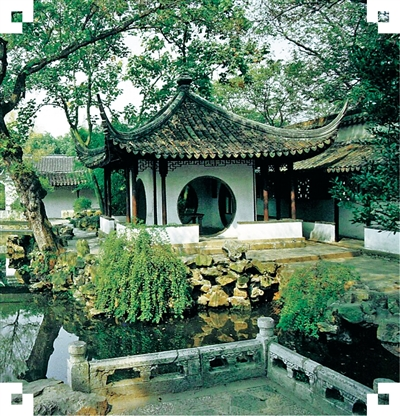
Classical Suzhou moon gates feature a full unbroken round arch embedded in smooth white plaster walls, topped with subtle grey tile eaves, often inscribed with poetic horizontal plaques. Famous examples include the four-sided moon gate pavilion Wuzhu Youju in Humble Administrator’s Garden, where every circular frame captures a distinct seasonal landscape view人民日报.
1.2 Deep Cultural Symbolism
- Circle = Heaven, Perfection & Wholeness Chinese cosmology follows the rule “heaven is round, earth is square”. The unbroken circular moon gate symbolizes celestial harmony, fullness, reunion and unbroken qi circulation, representing the ideal pursuit of balanced, complete life. The full-moon shape also evokes mid-autumn serenity, poetic moonlight and peaceful family unity.
- Threshold & Spiritual Transition Passing through a moon gate marks a shift from one spatial mood to another: from a busy outer courtyard to a quiet meditative pond zone, from mundane daily space to a secluded literati retreat. It acts as a gentle symbolic boundary separating the ordinary world from a tranquil natural sanctuary.
- Spatial Expansion via Framed Views The round arch functions as a natural painting frame. Even in compact walled gardens, a moon gate pulls distant rockery, water, pine trees or pagodas into view, executing the borrowed scenery technique to eliminate cramped spatial limits and create boundless visual depth.
1.3 Core Landscape Functions in Classical Gardens
- Framed View (Kuangjing): The most iconic function. Designers align moon gates with pre-planned focal points — Taihu rockery, lotus ponds, miniature pine trees — so every glance through the circle reveals a complete, balanced landscape composition.
- Step-by-Step Scenery Change: Winding paths lead visitors through successive moon gates, each unveiling a brand-new scene, realizing the classic garden principle “scenery shifts with every step”.
- Reflective Mirror Effect: When positioned beside still ponds, the circular arch doubles in water reflection, forming a full perfect circle and amplifying ethereal zen atmosphere.
- Soft Spatial Partition: Unlike solid dividing walls, moon gates separate zones without blocking sightlines or airflow, preserving visual connectivity while defining quiet independent garden corners.
1.4 Modern Minimalist Moon Gate Designs
Traditional heavy brick moon gates adapt easily to contemporary oriental and zen courtyards with simplified tweaks:
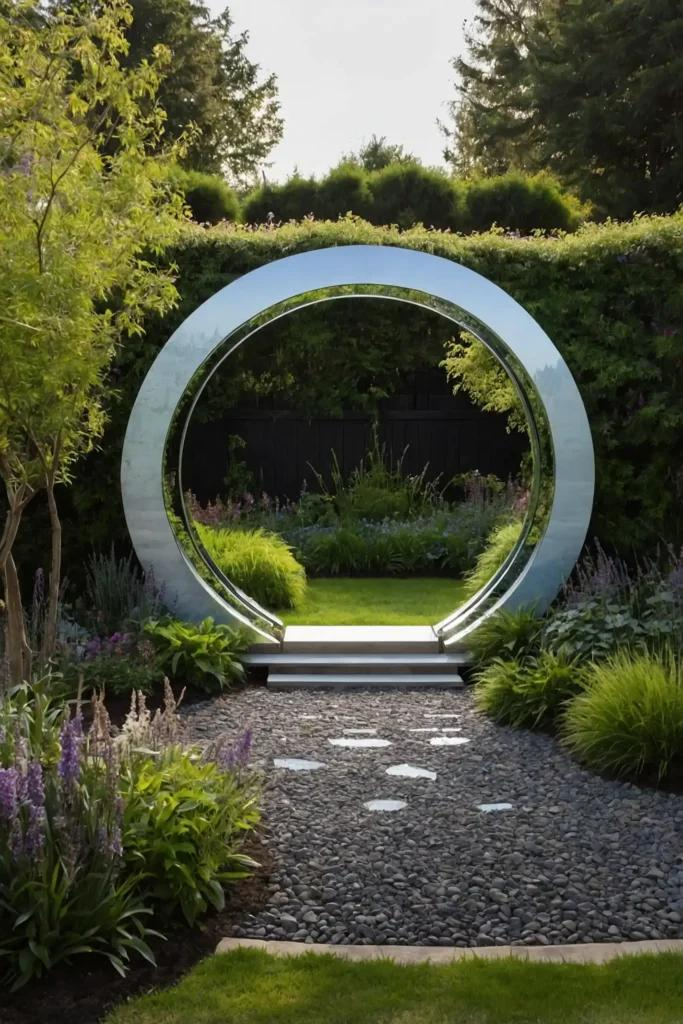
- Freestanding thin metal circular frames (corten steel or matte black metal) for small urban backyards, no full wall required
- Low half-height moon gate openings as partition screens on patios or tea room terraces
- Miniature carved stone moon gate ornaments for tabletop Chinese micro landscapes
- Glass-framed indoor moon gate dividers separating living spaces from courtyard greenery Design tip: Keep surrounding walls plain white or neutral grey; avoid over-decorating the arch frame to preserve clean Suzhou garden moon gate aesthetics and empty-space balance.
Part 2: Lattice Windows – Layered Light & Concealed Scenery Design
2.1 Definition & Historical Background
Lattice windows (also called leak windows / Louchuang) are hollow wooden or stone window panels carved with repeating geometric or auspicious patterns, embedded in garden boundary walls, pavilion sides and corridor partitions. Popularized in Jiangnan Ming-Qing gardens, they are the core carrier of Chinese lattice window scenery design, working alongside moon gates to control how much scenery is revealed or hidden.
Early lattice served practical structural support for paper window coverings; over time, craftsmen infused every pattern with symbolic meaning, turning functional windows into decorative cultural art that filters light, air and partial views simultaneously.
2.2 Classic Auspicious Lattice Patterns & Their Meanings
Each traditional lattice motif carries unique oriental symbolism, widely used in Suzhou classical gardens:
- Ice Crack Pattern (Bingwen): Fragmented intersecting lines, symbolize resilience, overcoming hardship and new vitality in spring.
- Ruyi Cloud Pattern: Curved soft cloud contours, represent good fortune, fulfilled wishes and gentle zen energy flow.
- Plum Blossom Lattice: Five-petaled floral frames, stand for integrity, purity and the three friends of winter spirit.
- Square Geometric Grid: Stable orderly lines, symbolize earth, stability and balanced courtyard layout.
- Interlocking Swastika (Wanzi): Continuous looping lines, signify eternal peace and endless auspiciousness.
2.3 Four Unique Landscape Functions of Lattice Windows
- Leaking Scenery (Loujing) – Partial Hidden Views Unlike full open moon gates, lattice patterns partially block sightlines, letting fragmented glimpses of outer bamboo, rockery or pond filter through gaps. This controlled concealment sparks imagination, a core tenet of zen empty-space aesthetics — viewers fill in the unseen scenery with their own perception, creating layered oriental landscape depth unavailable in fully open views.
- Dynamic Light & Shadow Play Sunlight streams through hollow lattice cutouts, casting shifting patterned shadows across walls, gravel ground and water surfaces. The moving shadow textures add subtle dynamic beauty without adding physical decor, enriching quiet zen garden atmosphere.
- Soft Boundary Separation Lattice walls divide garden zones without fully isolating them; air, light and partial scenery pass through gaps, avoiding the heavy, closed feeling of solid stone or concrete walls.
- Auxiliary Borrowed Scenery Tool When placed on outer boundary walls, lattice windows capture distant trees, mountain silhouettes or neighbouring greenery through patterned gaps, quietly executing distant and adjacent borrowed scenery techniques without large open openings.
2.4 Modern Lattice Window Applications for Zen Spaces
Simplified lattice designs fit small modern yards, balconies and indoor micro landscape decor:
- Low-height lattice partition screens separating patio seating and rockery zones
- Narrow lattice wall panels beside dry gravel zen streams to cast patterned shadows
- Mini wooden lattice cutouts as decorative backdrops for tabletop miniature gardens
- Simplified single-line cloud or ice-crack lattice on glass room dividers for tea rooms Design rule for minimalism: Pick one single lattice pattern per space; avoid mixing multiple complex motifs to maintain calm neutral zen tones.
Part 3: Coordinated Layout Logic – Pairing Moon Gates & Lattice Windows
In authentic classical Chinese garden layout, moon gates and lattice windows work as a matched visual system to control the rhythm of concealment and revelation:
- Main View Focal Point: Moon Gate Place one primary moon gate on the central viewing axis to frame the garden’s most important focal scenery (main rockery, central pond, pine tree). It delivers a full, complete framed view as the visitor’s main visual highlight.
- Secondary Texture & Side Views: Lattice Windows Line side boundary walls and corridor partitions with lattice windows to supply subtle partial scenery, shadow texture and layered detail without competing with the moon gate’s main focal power.
- Empty Space Matching Rule Reserve large blank plain wall areas between moon gates and lattice panels. Overfilling walls with openings destroys the core empty-space zen aesthetic; the contrast between solid white wall and hollow patterned openings creates visual breathing room and balanced qi flow.
- Seasonal View Coordination Align moon gate frames and lattice gaps to capture seasonal scenery: spring peach blossoms, summer lotus ponds, autumn red maples, winter snow-covered rockery, realizing seasonal borrowed scenery year-round.
Part 4: Step-by-Step Tips for Small Modern Garden Implementation
- Scale Matching for Compact Yards For tiny urban backyards or balcony layouts: choose low-profile half-moon gates instead of full tall circular arches, and slim narrow lattice panels, to avoid overwhelming limited space.
- Material Selection for Minimalist Zen Style
- Moon gates: Matte white stucco walls, weathered grey stone, thin corten steel, natural solid wood
- Lattice windows: Raw cedar, blackened bamboo, thin metal cutouts; skip glossy painted finishes
- Color Palette Control Stick to neutral muted tones: white walls, grey stone, natural wood brown, black metal; avoid bright coloured paint or ornate colourful carvings to retain quiet oriental serenity.
- Plant Framing Accents Frame moon gate edges with sparse dwarf bamboo, single pine trees or climbing wisteria (trimmed tightly). Do not plant dense overgrown foliage that blocks the circular viewing frame or lattice light gaps.
- Micro Landscape Miniature Versions For indoor tabletop zen micro gardens: use tiny carved stone moon gate figurines and miniature wooden lattice screens as decorative backdrop elements beside miniature rockery and raked sand water beds.
Common Design Mistakes to Avoid
- Overcrowding walls with dozens of moon gates and lattice windows, eliminating vital blank empty space
- Placing moon gates without aligning to a focal rockery, pond or tree, wasting the framed view function
- Using overly complex, multi-layered lattice patterns that create cluttered visual noise, breaking minimal zen aesthetics
- Allowing untrimmed fast-growing shrubs to block moon gate circular openings and lattice light gaps year-round
- Matching bright, glossy artificial stone or colourful painted lattice that clashes with soft Suzhou garden muted tone aesthetics
FAQ
What is the core difference between moon gates and lattice windows in Chinese garden design?
Moon gates are full circular open passageways designed to create complete framed views and spatial transitions between garden zones. Lattice windows are hollow patterned wall panels that filter partial scenery, light and shadow to build subtle layered texture, executing the “leaking scenery” technique central to Chinese lattice window scenery design.
What symbolic meaning does a moon gate carry?
The full circular form symbolizes heaven, perfection, harmony and reunion. Functionally, it acts as a visual painting frame to capture distant landscape via borrowed scenery, and a symbolic threshold separating ordinary space from a meditative zen retreat, the core of Suzhou garden moon gate aesthetics.
Can moon gates and lattice windows work for tiny urban backyards or balconies?
Absolutely. Simplified freestanding metal moon gate frames and slim lattice partition screens scale down perfectly for small outdoor spaces. Mini stone and wooden versions also serve as decorative accents for indoor tabletop miniature zen micro landscapes.
Which lattice pattern suits modern minimalist zen gardens best?
Ice crack patterns and simple ruyi cloud lattice are ideal. Their soft, restrained lines retain traditional oriental symbolism without excessive complex carving, matching empty-space minimalism and quiet slow-living atmosphere.
How do moon gates and lattice windows support the borrowed scenery technique?
Moon gates create wide unobstructed circular frames to capture distant hills, pagodas or trees outside garden walls. Lattice windows filter partial glimpses of adjacent boundary scenery through hollow gaps; together they expand perceived garden size without extending physical land boundaries.
Conclusion
Moon gates and lattice windows stand as the most recognizable iconic Chinese garden elements, encapsulating thousands of years of literati aesthetics, Taoist harmony philosophy and ingenious layered oriental landscape design.
The full circular moon gate delivers perfect framed views, symbolic celestial wholeness and seamless spatial transition, embodying timeless Suzhou garden moon gate aesthetics. Intricate lattice windows master the art of concealment and revelation, weaving shifting light, shadow and partial glimpses into garden walls to enrich quiet meditative atmosphere — the core of Chinese lattice window scenery design.
When paired mindfully with empty-space principles, sparse natural planting and neutral muted materials, these two classical architectural features translate seamlessly into modern small backyards, tea room interiors and miniature tabletop zen landscapes. They turn ordinary confined spaces into poetic, boundless oriental retreats, carrying forward the timeless spatial magic of traditional Chinese garden art.